More About This Card
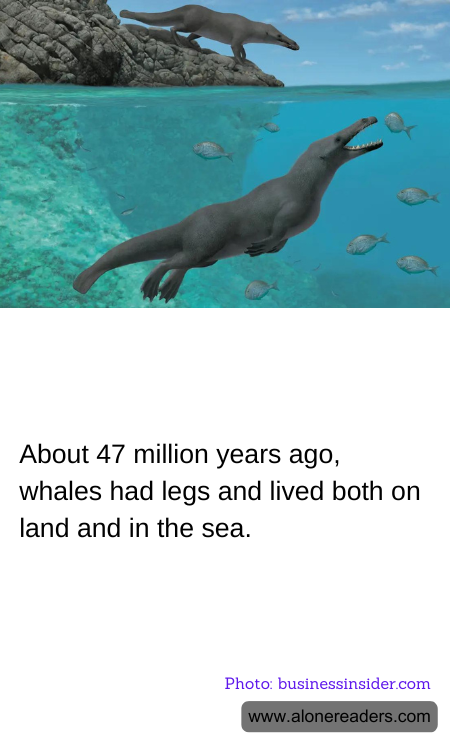
Around 47 million years ago, the ancestors of modern whales roamed both land and sea, a fascinating chapter in the evolutionary history of these majestic creatures. These early whales, known as archaeocetes, were a far cry from the streamlined giants we recognize today. Instead, they possessed legs and a body structure that allowed them to navigate both terrestrial and aquatic environments, showcasing a remarkable adaptability that would eventually lead them to become the ocean-dwelling mammals we are familiar with.
The transition from land to sea for these ancient whales was a gradual process, driven by the search for food and the need to escape predators. Fossil evidence reveals that these early whales had limbs capable of supporting their weight on land, yet they also had features suited for swimming. Their elongated bodies and powerful tails suggest they were adept at moving through water, while their limbs retained the ability to walk on land. This dual capability is a testament to the evolutionary pressures that shaped their development, allowing them to exploit a variety of ecological niches.
One of the most well-known examples of these early whales is Ambulocetus, often referred to as the "walking whale." This creature had robust limbs and a body that could support movement on land, but it also had webbed feet and a tail that made it an efficient swimmer. Ambulocetus represents a crucial link in the evolutionary chain, illustrating the gradual shift from land-dwelling to fully aquatic life. Over millions of years, natural selection favored traits that enhanced swimming ability, leading to the reduction of hind limbs and the development of flippers, ultimately resulting in the fully aquatic whales we see today.
The story of whales with legs is not just a tale of adaptation and survival; it is also a reminder of the dynamic nature of evolution. It highlights how species can undergo dramatic transformations in response to environmental changes and opportunities. The fossil record, with its wealth of transitional forms, provides a window into this incredible journey, offering insights into how life on Earth has evolved over millions of years.
For modern audiences, the tale of legged whales serves as a captivating example of nature's ingenuity. It underscores the interconnectedness of life and the shared ancestry of seemingly disparate species. As we continue to study these ancient creatures, we gain a deeper appreciation for the complexity and resilience of life on our planet. Understanding the evolutionary history of whales not only enriches our knowledge of the natural world but also inspires us to protect and preserve the diverse ecosystems that support life today.