More About This Card
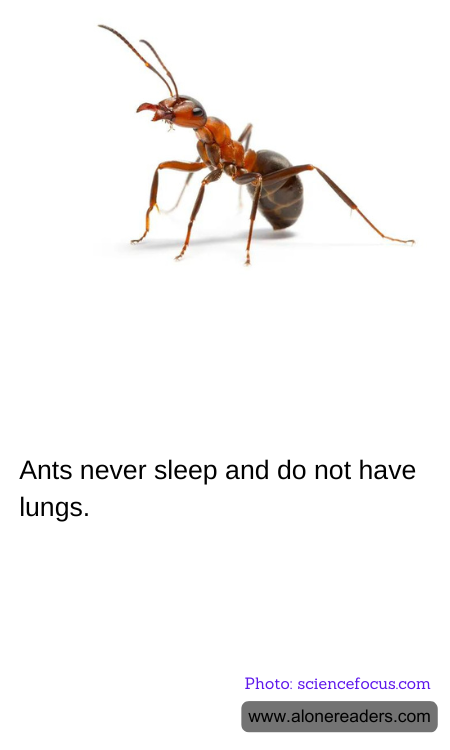
Ants are fascinating creatures that have intrigued scientists and nature enthusiasts alike for centuries. These tiny insects are known for their complex social structures and remarkable ability to work together in large colonies. However, two intriguing facts about ants often capture the curiosity of many: the belief that ants never sleep and the fact that they do not have lungs.
The idea that ants never sleep is a common misconception. In reality, ants do rest, but their sleep patterns are quite different from those of humans and other animals. Ants experience a series of short naps throughout the day and night, rather than a single, prolonged period of sleep. These naps can last for just a few minutes, allowing ants to remain active and responsive to their environment. This unique sleep pattern is essential for maintaining the efficiency and productivity of the colony, as it ensures that there are always ants available to perform necessary tasks such as foraging for food, caring for the young, and defending the nest.
Another fascinating aspect of ant biology is their lack of lungs. Unlike mammals, ants do not have a respiratory system that relies on lungs to exchange gases. Instead, ants breathe through a network of tiny tubes called tracheae, which are spread throughout their bodies. These tubes open to the outside through small holes called spiracles, allowing oxygen to diffuse directly into the ant's tissues and carbon dioxide to be expelled. This system is highly efficient for the small size of ants, enabling them to thrive in a variety of environments.
The absence of lungs and the unique sleep patterns of ants are just a few examples of how these insects have adapted to their ecological niches. Their ability to function without lungs is a testament to the incredible diversity of life on Earth and the myriad ways in which organisms have evolved to survive and thrive. Ants have been around for millions of years, and their success can be attributed to their adaptability and the highly organized structure of their colonies.
Understanding these aspects of ant biology not only satisfies our curiosity but also provides insights into the broader principles of evolution and adaptation. Ants, with their complex societies and efficient physiological systems, continue to be a source of inspiration and wonder. As we learn more about these remarkable insects, we gain a deeper appreciation for the intricate web of life that surrounds us and the countless ways in which nature has found solutions to the challenges of survival.