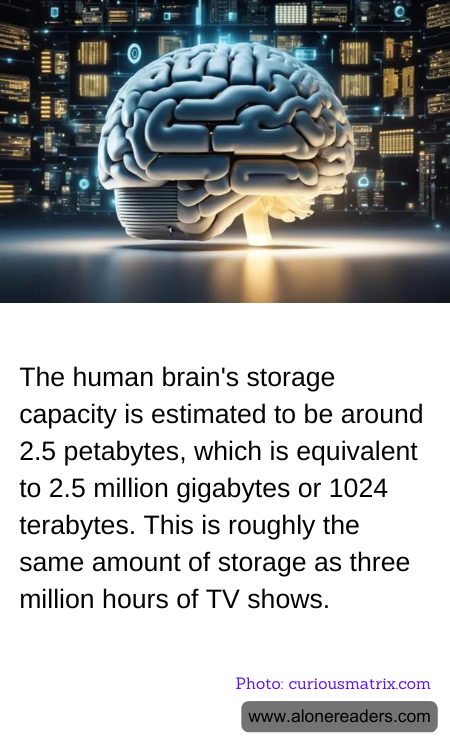
The human brain is an extraordinary organ, often described as the most complex structure in the known universe. One of its most fascinating aspects is its immense storage capacity, which scientists estimate to be around 2.5 petabytes. To put this into perspective, 2.5 petabytes is equivalent to 2.5 million gigabytes or 1,024 terabytes. This staggering amount of storage is roughly the same as three million hours of TV shows, highlighting the brain's incredible ability to store vast amounts of information.
The brain's storage capacity is not just about sheer volume; it also involves the intricate way it processes and retrieves information. Unlike a computer, which stores data in a linear and structured manner, the brain uses a complex network of neurons to store memories and knowledge. This network allows for a more dynamic and flexible way of handling information, enabling humans to learn, adapt, and recall experiences with remarkable efficiency. The brain's ability to form connections between different pieces of information is what makes human cognition so unique and powerful.
Moreover, the brain's storage capacity is not static. It is constantly evolving, with new experiences and learning opportunities leading to the formation of new neural connections. This adaptability is known as neuroplasticity, and it plays a crucial role in how we acquire new skills and knowledge throughout our lives. The brain's capacity to reorganize itself by forming new neural pathways ensures that we can continue to learn and grow, regardless of age.
Despite its vast storage capacity, the brain is remarkably efficient in how it uses its resources. It prioritizes information based on relevance and importance, often discarding or compressing less critical data to make room for new information. This selective memory process is why we sometimes forget trivial details while retaining important memories and skills. The brain's ability to filter and prioritize information is a testament to its sophisticated design and functionality.
In conclusion, the human brain's estimated storage capacity of 2.5 petabytes is a testament to its incredible complexity and efficiency. This vast storage potential, combined with the brain's dynamic processing capabilities, allows humans to learn, adapt, and thrive in an ever-changing world. As we continue to explore the mysteries of the brain, we gain a deeper appreciation for the remarkable organ that defines our humanity and shapes our experiences. Whether through scientific research or personal introspection, understanding the brain's capabilities offers valuable insights into the nature of human intelligence and potential.
