More About This Card
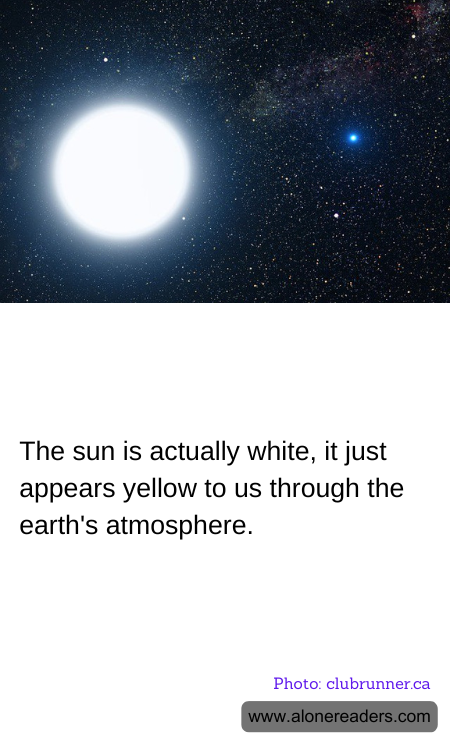
The sun, a magnificent celestial body at the center of our solar system, is often depicted in art and literature as a bright yellow orb. However, this common perception is a bit misleading. In reality, the sun is actually white. This fascinating fact is a result of the way light interacts with Earth's atmosphere, altering our perception of the sun's true color.
The sun emits light across the entire visible spectrum, which, when combined, appears white to the human eye. This is similar to how a prism works, splitting white light into the various colors of the rainbow. In space, where there is no atmosphere to interfere with its light, the sun indeed appears white. Astronauts aboard the International Space Station, for instance, observe the sun as a brilliant white sphere.
The reason we perceive the sun as yellow from Earth is due to a phenomenon known as Rayleigh scattering. As sunlight enters Earth's atmosphere, it collides with molecules and small particles. Shorter wavelengths of light, such as blue and violet, scatter more than longer wavelengths like red and yellow. However, our eyes are more sensitive to blue light, and the violet light is mostly absorbed by the ozone layer, leaving the sky predominantly blue. This scattering effect causes the direct sunlight that reaches our eyes to be stripped of some of its shorter wavelengths, making the sun appear more yellowish.
This effect is even more pronounced during sunrise and sunset. When the sun is low on the horizon, its light has to pass through a greater thickness of the Earth's atmosphere. This increased distance scatters even more of the shorter wavelengths, allowing the longer red and orange wavelengths to dominate, giving the sun its characteristic reddish hue during these times.
Understanding the true color of the sun not only enriches our appreciation of the natural world but also highlights the intricate interplay between light and the Earth's atmosphere. It serves as a reminder of the complex and beautiful science that underlies everyday phenomena. While the sun may appear yellow to us from the ground, its true white light is a testament to the vast spectrum of colors it encompasses, illuminating our world in more ways than one.
This knowledge bridges the gap between scientific understanding and everyday observation, offering a glimpse into the wonders of our universe. It encourages us to look beyond appearances and explore the underlying truths of the world around us, fostering a deeper connection with the cosmos and the natural laws that govern it.