More About This Card
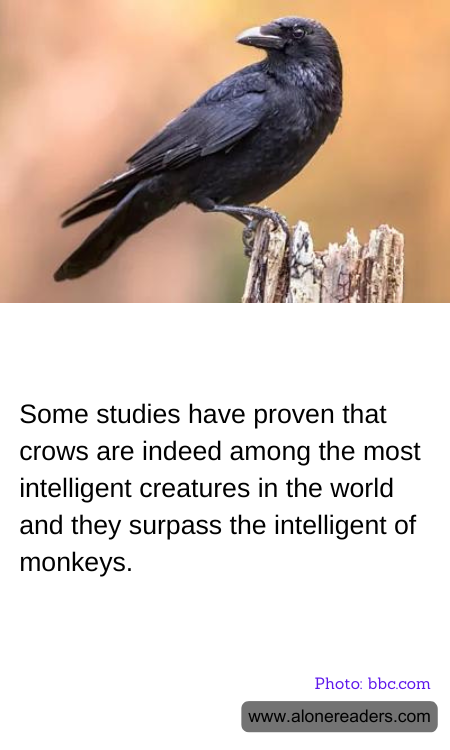
In the realm of animal intelligence, crows have emerged as remarkable contenders, often surprising researchers with their cognitive abilities. Recent studies have shown that these avian creatures not only possess intelligence comparable to that of primates but, in some cases, even surpass them. This revelation has sparked a renewed interest in understanding the cognitive capabilities of birds, particularly crows, and has challenged long-held assumptions about the hierarchy of animal intelligence.
Crows belong to the corvid family, which also includes ravens, magpies, and jays. These birds have long been observed exhibiting behaviors that suggest a high level of intelligence, such as using tools, solving complex problems, and demonstrating social learning. In a series of experiments, crows have been shown to use sticks to extract insects from tree bark, a behavior once thought to be exclusive to primates. Moreover, they have been observed bending wires into hooks to retrieve food from hard-to-reach places, showcasing their ability to manipulate objects in innovative ways.
One of the most compelling pieces of evidence supporting the intelligence of crows is their problem-solving skills. In controlled experiments, crows have demonstrated the ability to solve multi-step puzzles that require planning and foresight. For instance, they can understand the concept of water displacement, using stones to raise the water level in a container to access floating food. This level of problem-solving indicates not only an understanding of cause and effect but also the ability to apply learned knowledge to new situations.
Crows also exhibit sophisticated social behaviors, which are indicative of their intelligence. They are known to engage in complex social interactions, such as forming alliances and recognizing individual human faces. Studies have shown that crows can remember faces of people who have posed a threat to them and will communicate this information to other crows, effectively teaching them to avoid potential dangers. This ability to learn from others and pass on knowledge is a hallmark of advanced cognitive function.
The intelligence of crows challenges the traditional view that primates are the pinnacle of animal cognition. While monkeys and apes have long been celebrated for their intellectual capabilities, the cognitive feats of crows suggest that intelligence can manifest in diverse forms across different species. This realization has profound implications for our understanding of animal intelligence and the evolutionary processes that shape it.
In conclusion, the intelligence of crows is a testament to the complexity and diversity of the animal kingdom. Their ability to use tools, solve intricate problems, and engage in sophisticated social behaviors highlights the remarkable cognitive abilities of these birds. As research continues to uncover the depths of crow intelligence, it becomes increasingly clear that these avian creatures deserve recognition as some of the most intelligent beings in the natural world. This newfound appreciation for crows not only enriches our understanding of animal cognition but also invites us to reconsider the ways in which we perceive and interact with the natural world around us.