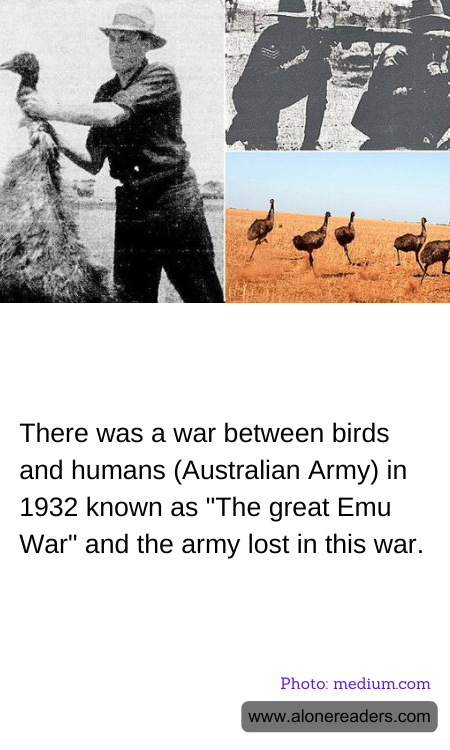
In the annals of history, there are many tales of battles fought and won, but few are as peculiar as the Great Emu War of 1932. This unusual conflict took place in the vast, arid landscapes of Western Australia and pitted the might of the Australian Army against a formidable foe: the emu. These large, flightless birds, native to Australia, became the unlikely adversaries in a war that would end in a surprising defeat for the humans.
The origins of this bizarre conflict can be traced back to the aftermath of World War I. Many Australian veterans, seeking to rebuild their lives, were encouraged to take up farming in the country's rural areas. However, as the Great Depression took hold, these farmers faced significant challenges, including plummeting wheat prices and a severe drought. To make matters worse, a massive migration of emus descended upon the farmlands of Western Australia in search of food and water, wreaking havoc on crops and fences.
Faced with the destruction of their livelihoods, the farmers turned to the government for help. In response, the Australian military was deployed to tackle the emu menace. Armed with machine guns and led by Major G.P.W. Meredith, the soldiers embarked on a mission to curb the emu population. However, the emus proved to be elusive and surprisingly resilient. Their speed and agility allowed them to evade the soldiers' gunfire, and their sheer numbers overwhelmed the military's efforts.
The campaign, which lasted from November to December 1932, was marked by a series of comical and frustrating encounters. Despite the soldiers' best efforts, the emus managed to outmaneuver them time and again. The birds' ability to scatter and regroup made it nearly impossible for the military to make a significant impact. Reports from the time describe how the emus would often split into smaller groups, making them difficult targets for the soldiers' machine guns.
In the end, the Great Emu War concluded with the emus emerging victorious. The military withdrew, having failed to significantly reduce the emu population. The operation was deemed a failure, and the emus continued to roam the farmlands, much to the chagrin of the farmers. The government eventually resorted to other measures, such as offering bounties for emu kills, to address the issue.
The Great Emu War remains a curious footnote in history, a testament to the unpredictability of nature and the limits of human intervention. It serves as a reminder that not all battles are won with superior firepower and that sometimes, the most unexpected adversaries can prove to be the most formidable. Today, the story of the Great Emu War is often recounted with a sense of humor and incredulity, a quirky chapter in Australia's rich tapestry of history.
