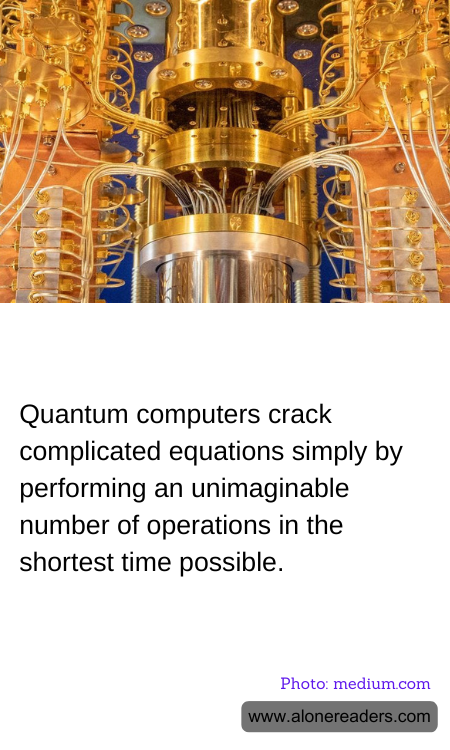
In the realm of technology and computation, quantum computers stand as a beacon of revolutionary potential, promising to transform the way we solve complex problems. Unlike classical computers, which process information in binary bits (0s and 1s), quantum computers utilize quantum bits, or qubits, which can exist in multiple states simultaneously. This unique capability allows quantum computers to perform an unimaginable number of operations at once, tackling complicated equations with unprecedented speed and efficiency.
The power of quantum computing lies in its ability to leverage the principles of quantum mechanics, such as superposition and entanglement. Superposition allows qubits to represent multiple possibilities at the same time, while entanglement enables qubits that are entangled to be interconnected, such that the state of one qubit can depend on the state of another, no matter the distance between them. These properties enable quantum computers to explore a vast number of potential solutions simultaneously, rather than sequentially as classical computers do.
This parallelism is particularly advantageous when dealing with problems that involve a large number of variables and complex interactions, such as those found in cryptography, optimization, and material science. For instance, in cryptography, quantum computers have the potential to break encryption codes that would take classical computers millions of years to crack. Similarly, in optimization problems, quantum algorithms can identify the best solution from a multitude of possibilities in a fraction of the time required by traditional methods.
Despite their immense potential, quantum computers are still in the early stages of development. Building and maintaining a quantum computer is a formidable challenge due to the delicate nature of qubits, which are highly susceptible to environmental disturbances. Researchers are actively working on improving error rates and developing more stable qubits to make quantum computing more practical and accessible.
As we continue to advance in this field, the implications of quantum computing are vast. Industries ranging from pharmaceuticals to finance could be transformed by the ability to solve complex equations and simulate molecular interactions with unparalleled precision. This could lead to breakthroughs in drug discovery, risk analysis, and even artificial intelligence.
The journey towards fully functional and widely available quantum computers is ongoing, but the progress made thus far is promising. As scientists and engineers overcome the current limitations, the day when quantum computers become a staple tool for solving the world's most challenging problems draws nearer. The potential of quantum computing to crack complicated equations simply and swiftly is not just a technological marvel; it is a glimpse into the future of computation, where the impossible becomes possible.
