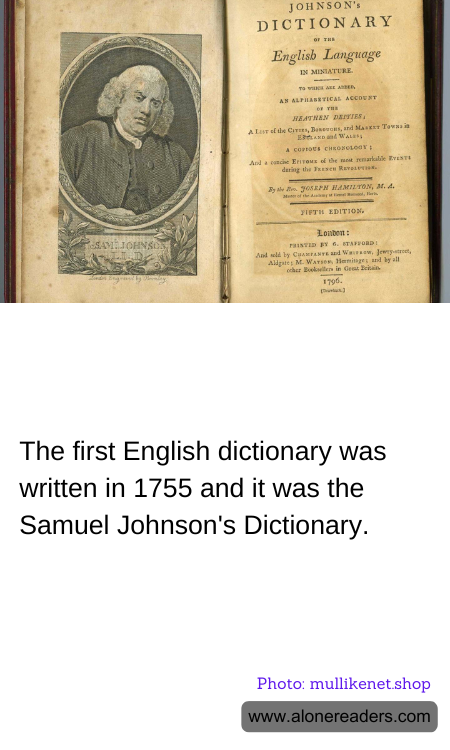
In the annals of English literature and lexicography, the year 1755 stands as a monumental milestone. It was in this year that Samuel Johnson, a towering figure in English letters, published "A Dictionary of the English Language." This work was not merely a collection of words and definitions; it was a comprehensive and scholarly endeavor that laid the foundation for modern English dictionaries and significantly influenced the way the English language was understood and used.
Before Johnson's dictionary, the English language lacked a comprehensive and authoritative reference. Various smaller dictionaries existed, but they were often inconsistent and incomplete. The absence of a standardized dictionary posed challenges for writers, scholars, and anyone who sought to master the language. Samuel Johnson, with his profound understanding of English literature and language, took on the Herculean task of compiling a dictionary that would serve as a definitive guide.
Johnson's dictionary was remarkable not only for its breadth but also for its depth. It contained over 40,000 entries, each meticulously defined and illustrated with quotations from the great works of English literature. Johnson's use of literary quotations was particularly innovative, as it provided context and demonstrated how words were used in practice. This approach not only enriched the dictionary but also made it a treasure trove for lovers of literature.
The dictionary took nearly nine years to complete, a testament to Johnson's dedication and scholarly rigor. Despite the enormity of the task, Johnson worked largely alone, with only a small team of assistants. His work was funded by a group of booksellers who recognized the importance of such a project. When it was finally published, the dictionary was hailed as a masterpiece of scholarship and quickly became an indispensable resource for writers, educators, and students.
One of the most endearing aspects of Johnson's dictionary is its reflection of his personality and wit. Unlike modern dictionaries, which strive for objectivity and neutrality, Johnson's entries often included his personal opinions and humor. For instance, his definition of "lexicographer" as "a harmless drudge" reveals his self-deprecating humor and the challenges he faced during the compilation process.
Samuel Johnson's dictionary was more than just a linguistic tool; it was a cultural artifact that captured the richness and complexity of the English language. It set a new standard for lexicography and inspired future generations of dictionary makers. Today, while modern dictionaries have evolved and expanded, Johnson's work remains a testament to the power of language and the enduring legacy of one man's vision and perseverance.
In conclusion, Samuel Johnson's "A Dictionary of the English Language" was a pioneering achievement that transformed the landscape of English lexicography. It provided a much-needed structure to the language and continues to be celebrated for its scholarly excellence and literary charm. As we navigate the ever-evolving world of language, Johnson's dictionary reminds us of the importance of words and the profound impact they have on our understanding of the world.
