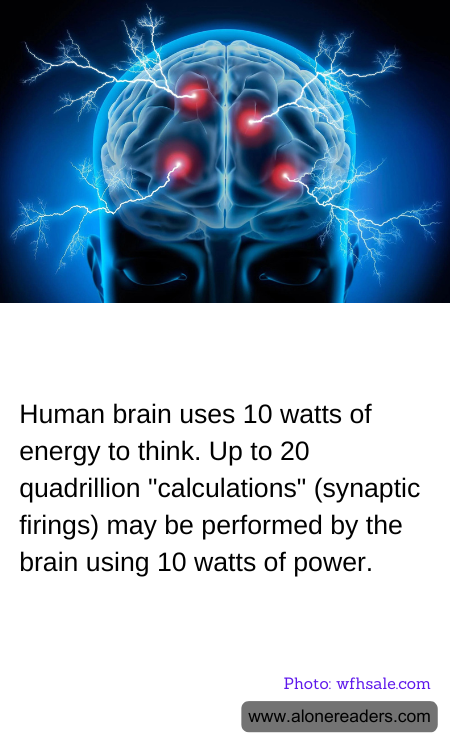
More About This Card
The human brain is a marvel of biological engineering, capable of performing an astonishing number of tasks with remarkable efficiency. One of the most intriguing aspects of this organ is its energy consumption. Despite its complex functions, the brain operates on just 10 watts of power, roughly equivalent to the energy used by a dim light bulb. This modest energy requirement powers an extraordinary number of synaptic firings, estimated to be up to 20 quadrillion calculations per second.
This efficiency is a testament to the brain's evolutionary refinement. Unlike computers, which require significant energy to perform complex calculations, the brain's architecture allows it to execute a vast array of functions with minimal power. Neurons, the brain's primary cells, communicate through synapses, where chemical and electrical signals are exchanged. Each synaptic firing represents a "calculation," and the brain's ability to perform these at such a high rate with limited energy is unparalleled in the natural world.
The brain's energy efficiency is crucial for its functionality. Given its role in regulating bodily functions, processing sensory information, and enabling thought and emotion, the brain must operate continuously without exhausting the body's energy reserves. This efficiency is achieved through a combination of factors, including the brain's ability to prioritize tasks, its use of energy-saving neurotransmitters, and the highly specialized nature of its neural networks.
Understanding the brain's energy use also sheds light on its limitations. While the brain is incredibly efficient, it is not infallible. Fatigue, stress, and lack of sleep can impair its ability to function optimally, as these conditions affect the brain's energy management. This underscores the importance of maintaining a healthy lifestyle to support brain health, including proper nutrition, regular exercise, and adequate rest.
The brain's energy efficiency has inspired researchers and engineers in the field of artificial intelligence and computing. By studying how the brain manages to perform complex tasks with minimal energy, scientists hope to develop more efficient computing systems. This could lead to advancements in technology that mimic the brain's ability to process information quickly and efficiently, potentially revolutionizing fields such as robotics, data processing, and machine learning.
In conclusion, the human brain's ability to perform up to 20 quadrillion calculations per second using just 10 watts of power is a remarkable feat of nature. This efficiency not only highlights the brain's evolutionary sophistication but also provides valuable insights for technological innovation. As we continue to explore the mysteries of the brain, we may unlock new ways to enhance both human and machine capabilities, paving the way for a future where technology and biology work in harmony.