More About This Card
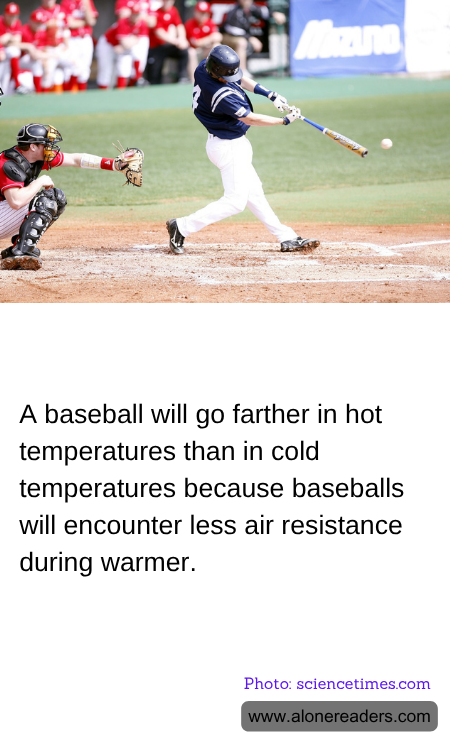
Baseball, often referred to as America's pastime, is a sport deeply rooted in tradition and science. One intriguing aspect of the game that has captured the curiosity of players and fans alike is how weather conditions, particularly temperature, can influence the flight of a baseball. It is a well-observed phenomenon that a baseball tends to travel farther in hot temperatures than in cold ones, and the underlying reason for this lies in the physics of air resistance.
Air resistance, or drag, is a force that opposes the motion of an object through the air. It plays a significant role in determining how far a baseball will travel once it is hit. The density of the air is a critical factor in the amount of drag a baseball encounters. In warmer temperatures, the air is less dense compared to colder temperatures. This is because heat causes air molecules to move more rapidly and spread apart, reducing the number of molecules in a given volume of air. Consequently, a baseball traveling through warmer air faces less resistance, allowing it to maintain its speed and travel a greater distance.
Conversely, in colder temperatures, the air is denser. The molecules are packed more closely together, increasing the drag on the baseball. This increased resistance slows the ball down more quickly, reducing the distance it can travel. This is why players often notice that their hits don't carry as far on chilly days compared to warm, sunny ones.
The impact of temperature on the flight of a baseball is not just a theoretical concept; it has practical implications for players and teams. Understanding how weather conditions affect the game can influence strategies and decisions, such as choosing the right time of day for a game or selecting the best equipment. For instance, pitchers might adjust their techniques to account for the increased drag in colder weather, while hitters might alter their approach to maximize their chances of hitting home runs in warmer conditions.
Moreover, this phenomenon highlights the intricate relationship between sports and science. It serves as a reminder that even in a game as traditional as baseball, scientific principles are at play, influencing outcomes in subtle yet significant ways. Fans and players alike can appreciate the blend of skill, strategy, and science that makes baseball such a fascinating sport.
In conclusion, the distance a baseball travels is not solely determined by the strength and skill of the player but is also significantly influenced by the temperature of the environment. Warmer temperatures reduce air resistance, allowing the ball to travel farther, while colder temperatures increase resistance and shorten its flight. This interplay between physics and sports adds an extra layer of depth to the game, making each hit and each pitch a testament to the fascinating world of science in action.