More About This Card
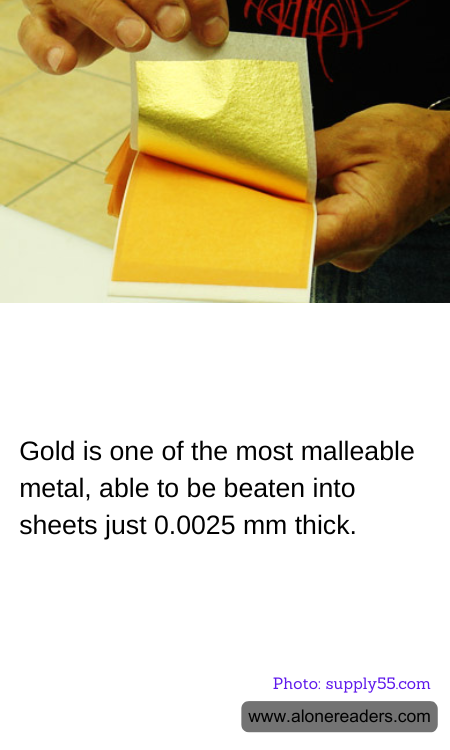
Gold, a metal that has fascinated humanity for millennia, is renowned not only for its lustrous beauty and intrinsic value but also for its remarkable physical properties. Among these, its malleability stands out as one of its most extraordinary characteristics. Malleability refers to a material's ability to be deformed under compressive stress, and gold excels in this aspect more than any other metal. It can be beaten into sheets as thin as 0.0025 millimeters, a testament to its unique atomic structure and the strength of its metallic bonds.
This exceptional malleability allows gold to be used in a variety of applications, both practical and decorative. In the world of art and architecture, gold leaf—ultra-thin sheets of gold—has been used for centuries to adorn everything from religious icons to the domes of grand buildings. The ability to create such thin sheets without breaking is due to the way gold atoms slide over each other without losing cohesion, a property that is not as pronounced in other metals.
In addition to its aesthetic uses, gold's malleability has significant implications in technology and industry. In electronics, for example, gold is often used to make connectors and circuit boards. Its ability to be drawn into thin wires and sheets ensures that it can be used to create precise and reliable connections in devices that require high conductivity and resistance to corrosion. This makes gold an indispensable component in the manufacture of smartphones, computers, and other electronic devices that are integral to modern life.
Moreover, gold's malleability is not just a boon for artisans and engineers; it also plays a crucial role in scientific research. In laboratories, gold is used to create thin films that serve as substrates for various experiments. These films can be used to study the properties of other materials or to develop new technologies, such as sensors and catalysts, that rely on the unique properties of gold.
The ability to manipulate gold into such fine forms also highlights the importance of craftsmanship and skill. The process of creating gold leaf, for instance, requires a meticulous technique that has been refined over centuries. Craftsmen must carefully hammer the gold, gradually thinning it while maintaining its integrity. This delicate balance of art and science underscores the enduring allure of gold, a metal that continues to captivate and inspire.
In conclusion, gold's malleability is a defining feature that enhances its versatility and value. Whether in the hands of artists, engineers, or scientists, gold's ability to be shaped into incredibly thin sheets opens up a world of possibilities. Its unique properties ensure that it remains a vital material in both traditional and cutting-edge applications, bridging the past with the future in a way that few other materials can.