More About This Card
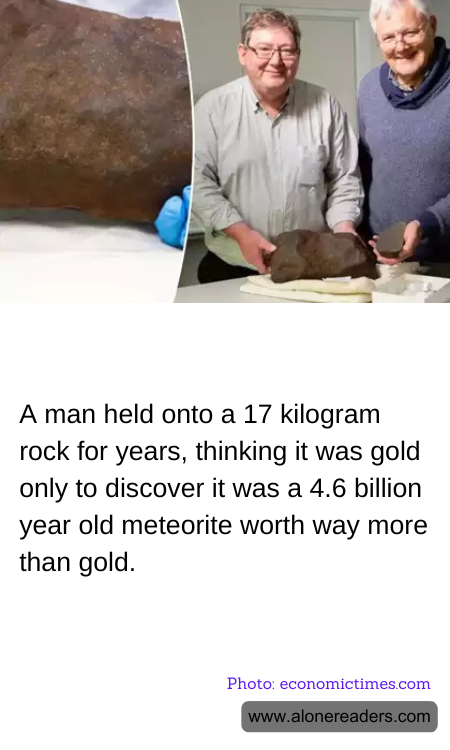
In a fascinating twist of fate, a man in Australia discovered that a rock he had been holding onto for years, believing it to be a gold nugget, was actually a 4.6 billion-year-old meteorite. This revelation not only transformed his understanding of the rock's value but also provided scientists with a rare glimpse into the early solar system.
The story began when David Hole, an amateur prospector, stumbled upon the hefty 17-kilogram rock in 2015 while exploring Maryborough Regional Park near Melbourne. The area is known for its rich gold deposits, and Hole was hopeful that his find was a significant gold nugget. Despite its unusual appearance and weight, he was convinced of its potential value. Over the years, he tried various methods to crack it open, including using a rock saw, a drill, and even acid, but the rock remained stubbornly intact.
It wasn't until Hole decided to take the rock to the Melbourne Museum that its true nature was revealed. Geologist Dermot Henry, who examined the rock, immediately recognized it as something extraordinary. The rock's density and composition were unlike any typical terrestrial rock. Further analysis confirmed that it was a meteorite, a remnant from the early solar system, estimated to be around 4.6 billion years old.
Meteorites are incredibly rare, and this particular specimen, named the Maryborough Meteorite, is especially significant. It is composed primarily of iron and nickel, elements that are not commonly found in such concentrations on Earth. The meteorite's age and composition offer scientists a unique opportunity to study the conditions and materials present during the formation of our solar system.
The discovery has sparked excitement in the scientific community, as meteorites can provide invaluable insights into the processes that shaped our planetary neighborhood. Unlike gold, which is valued for its monetary worth, meteorites are prized for their scientific significance. The Maryborough Meteorite is now considered far more valuable than any gold nugget, both in terms of its rarity and the knowledge it can impart.
For David Hole, the realization that his rock was not gold but something far more precious was a humbling experience. His story serves as a reminder of the wonders that can be found in the natural world and the importance of curiosity and perseverance. It also highlights the potential for everyday discoveries to contribute to our understanding of the universe.
In the end, what began as a quest for gold turned into a journey of scientific discovery, proving that sometimes, the true treasure lies not in material wealth but in the knowledge and wonder that the natural world has to offer.