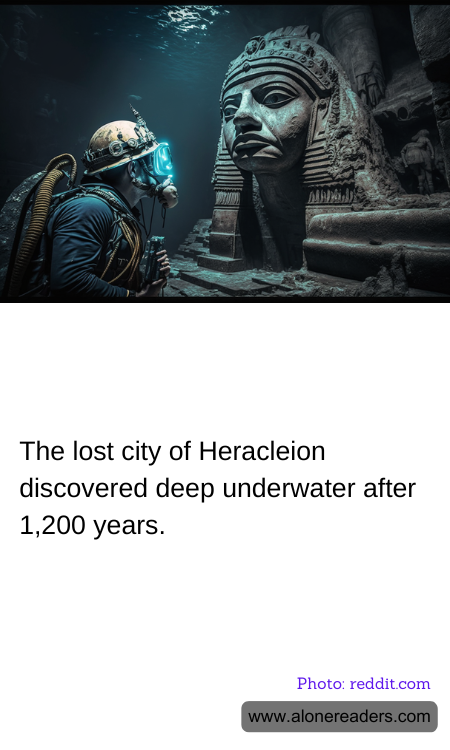
Beneath the shimmering waters of the Mediterranean Sea, off the coast of Egypt, lies a city that was once thought to be nothing more than a myth. Heracleion, also known as Thonis in ancient Egyptian, was a bustling port city that vanished beneath the waves over 1,200 years ago. Its rediscovery has captivated archaeologists and history enthusiasts alike, offering a tantalizing glimpse into a world long lost to time.
Heracleion was a major trading hub in the ancient world, strategically located at the mouth of the Nile River. It served as a gateway for goods and cultures between Egypt and the Mediterranean. The city was renowned for its grand temples, bustling markets, and vibrant streets. However, due to a combination of natural disasters, including earthquakes and rising sea levels, Heracleion gradually sank into the sea, its existence fading into legend.
The city remained hidden until the year 2000 when a team of French underwater archaeologists, led by Franck Goddio, made the remarkable discovery. Using advanced sonar technology, they uncovered the submerged ruins of Heracleion, revealing a treasure trove of artifacts that had been preserved in the silt and sand for centuries. Among the findings were colossal statues, inscriptions, and everyday objects that painted a vivid picture of life in the ancient city.
One of the most striking discoveries was the statue of Hapi, the god of the Nile's annual flooding, which stood over five meters tall. This and other statues were found in remarkably good condition, offering insights into the religious practices and artistic achievements of the time. Inscriptions and steles uncovered from the site have provided valuable information about the city's history, its rulers, and its role in the ancient world.
The rediscovery of Heracleion has not only enriched our understanding of ancient Egyptian civilization but also highlighted the importance of underwater archaeology. The preservation of the city beneath the sea has allowed researchers to study artifacts in their original context, offering a unique perspective on the past. The findings have also sparked interest in the potential for other lost cities waiting to be discovered beneath the world's oceans.
Heracleion's story is a poignant reminder of the impermanence of human achievements and the power of nature. As researchers continue to explore the submerged city, they are piecing together a narrative that bridges the gap between myth and history. The lost city of Heracleion, once a bustling center of commerce and culture, now serves as a silent testament to the passage of time and the enduring mysteries of the ancient world.
