More About This Card
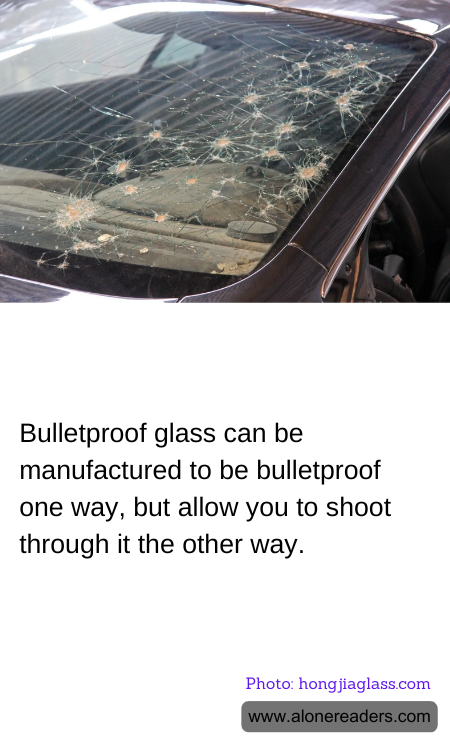
In the realm of security and defense, innovations are constantly being developed to enhance safety measures while maintaining functionality. One such fascinating advancement is the creation of bulletproof glass that is designed to be bulletproof from one side while allowing projectiles to pass through from the other. This intriguing technology not only challenges conventional perceptions of bulletproof materials but also opens up new possibilities for security applications.
Traditional bulletproof glass is engineered to withstand the impact of bullets, providing protection by absorbing and dispersing the energy of the projectile. It is typically composed of multiple layers of glass and polycarbonate materials, laminated together to create a strong, resilient barrier. However, the concept of one-way bulletproof glass introduces a unique twist to this technology. By manipulating the materials and structure, manufacturers can create a surface that remains impervious to bullets from one direction while allowing them to pass through from the opposite side.
The science behind this one-way bulletproof glass involves a combination of advanced materials and precise engineering. The key lies in the arrangement and composition of the layers. On the side intended to be bulletproof, the glass is designed to absorb and disperse the energy of incoming bullets, much like traditional bulletproof glass. On the opposite side, however, the layers are configured in such a way that they do not impede the passage of bullets. This is achieved through meticulous control of the glass's thickness, density, and the properties of the interlayer materials.
The potential applications for this technology are vast and varied. In military and law enforcement scenarios, one-way bulletproof glass could provide a strategic advantage, allowing personnel to return fire while remaining protected. It could be used in vehicles, guard posts, or secure facilities where the ability to shoot back without compromising safety is crucial. Additionally, this technology could find applications in high-security environments, such as banks or government buildings, where maintaining a defensive position is paramount.
Despite its promising applications, the development and deployment of one-way bulletproof glass also raise important considerations. The ethical implications of such technology must be carefully evaluated, particularly in terms of its use in civilian contexts. Ensuring that this technology is used responsibly and does not fall into the wrong hands is a critical concern for manufacturers and regulators alike.
In conclusion, the development of one-way bulletproof glass represents a significant leap forward in security technology. By allowing for defensive and offensive capabilities within the same material, it offers a unique solution to complex security challenges. As research and development continue, it will be essential to balance innovation with ethical considerations, ensuring that this technology is used to enhance safety and security for all.