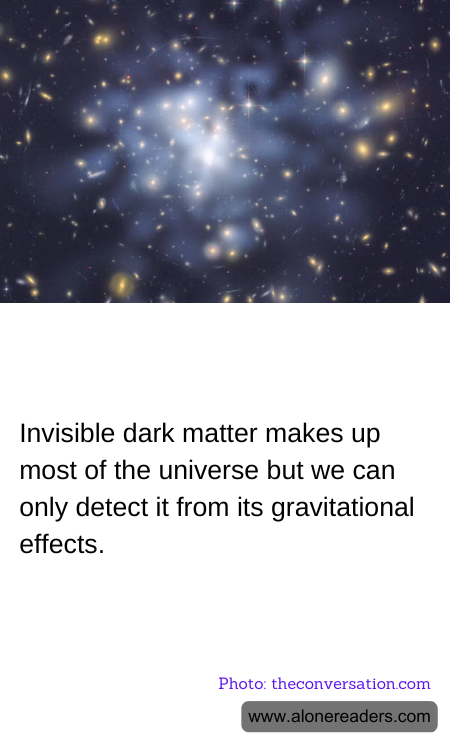
In the vast expanse of the universe, a mysterious and invisible substance known as dark matter plays a crucial role in shaping the cosmos. Despite its elusive nature, dark matter is believed to make up approximately 27% of the universe, far surpassing the mere 5% that constitutes the ordinary matter we can see and touch. The remaining 68% is attributed to dark energy, another enigmatic force driving the accelerated expansion of the universe. While dark matter cannot be observed directly, its presence is inferred through its gravitational effects on visible matter, radiation, and the large-scale structure of the universe.
The concept of dark matter emerged from the need to explain discrepancies in the rotational speeds of galaxies. In the 1930s, astronomer Fritz Zwicky observed that galaxies within the Coma Cluster were moving at speeds that could not be accounted for by the visible mass alone. He proposed the existence of an unseen mass, which he termed "dark matter," to account for the gravitational pull necessary to hold the cluster together. Decades later, further evidence came from the work of Vera Rubin, who studied the rotation curves of spiral galaxies. She found that stars at the outer edges of galaxies were orbiting at unexpected speeds, suggesting the presence of a massive, invisible halo of dark matter enveloping each galaxy.
Dark matter's gravitational influence extends beyond individual galaxies. It is a fundamental component in the formation and evolution of cosmic structures. Computer simulations of the universe's growth show that dark matter acts as a cosmic scaffold, guiding the formation of galaxies and galaxy clusters. Without dark matter, the universe as we know it would not exist. Its gravitational pull helps to bind galaxies together, preventing them from flying apart and allowing them to coalesce into the intricate web-like structures observed in the cosmos.
Despite its significant role, the true nature of dark matter remains one of the greatest mysteries in modern astrophysics. Scientists have proposed various candidates for dark matter particles, such as Weakly Interacting Massive Particles (WIMPs) and axions, but none have been conclusively detected. Experiments around the world, including those conducted deep underground and in space, continue to search for these elusive particles, hoping to unlock the secrets of dark matter.
The study of dark matter not only challenges our understanding of the universe but also pushes the boundaries of physics. It invites us to explore realms beyond the visible and to question the very fabric of reality. As researchers delve deeper into the mysteries of dark matter, they are driven by the hope that unraveling its secrets will provide profound insights into the fundamental workings of the universe. Until then, dark matter remains an invisible yet indispensable player in the cosmic dance, shaping the universe in ways we are only beginning to comprehend.
