More About This Card
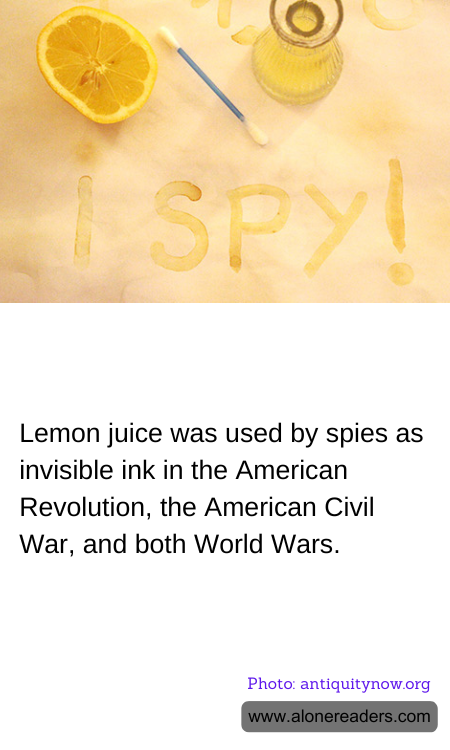
Throughout history, the art of espionage has played a crucial role in shaping the outcomes of wars and revolutions. One of the most intriguing tools in the spy's arsenal was the use of invisible ink, a simple yet effective method of covert communication. Among the various substances employed for this purpose, lemon juice stands out as a particularly fascinating choice. Its use as invisible ink spans several significant conflicts, including the American Revolution, the American Civil War, and both World Wars.
The concept of using lemon juice as invisible ink is based on its acidic properties. When applied to paper, lemon juice is virtually undetectable. However, when the paper is heated, the acid in the juice oxidizes and turns brown, revealing the hidden message. This simple chemical reaction made lemon juice an ideal choice for secret communication, as it required no special equipment and could be easily concealed.
During the American Revolution, spies on both sides of the conflict utilized lemon juice to transmit sensitive information. The ability to send messages undetected was crucial in a time when intercepted correspondence could lead to dire consequences. Spies would write their messages between the lines of ordinary letters or on seemingly innocuous documents, ensuring that only the intended recipient, who knew to apply heat, could read the hidden text.
The use of lemon juice as invisible ink continued into the American Civil War, where both Union and Confederate spies employed it to convey strategic information. The simplicity and effectiveness of this method made it a popular choice among operatives who needed to communicate without arousing suspicion. In an era when communication technology was limited, such innovative techniques were invaluable.
As the world plunged into the chaos of the World Wars, the need for secure communication became even more critical. Spies and resistance fighters across Europe and beyond relied on invisible ink to pass on vital intelligence. Lemon juice, along with other substances like milk and vinegar, was used to write messages that could be easily concealed and later revealed by applying heat. This method allowed operatives to maintain a clandestine flow of information, often under the noses of enemy forces.
The legacy of lemon juice as invisible ink is a testament to human ingenuity and the timeless need for secrecy in times of conflict. While modern technology has largely replaced such rudimentary methods, the stories of spies using everyday substances to outwit their adversaries continue to capture the imagination. These tales remind us of the resourcefulness and courage of those who operated in the shadows, risking everything to ensure that crucial information reached its destination.
In an age where digital encryption dominates the field of secure communication, the humble lemon juice serves as a charming reminder of a time when the simplest solutions were often the most effective. Its role in history underscores the importance of creativity and adaptability in the face of adversity, qualities that remain as relevant today as they were centuries ago.