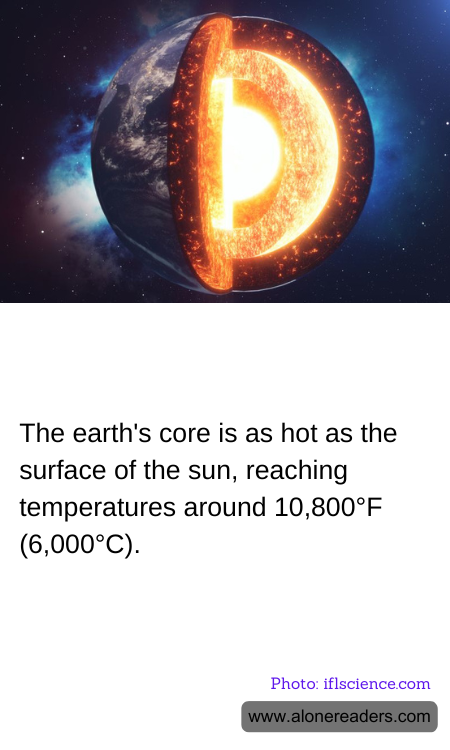
Deep beneath our feet lies a realm of extreme heat and pressure, a place that remains largely mysterious despite being the very heart of our planet. The Earth's core, a searing sphere of molten and solid metal, reaches temperatures comparable to the surface of the sun, soaring to around 10,800°F (6,000°C). This astonishing fact not only highlights the dynamic nature of our planet but also underscores the incredible forces at play beneath the Earth's crust.
The Earth's core is divided into two parts: the outer core and the inner core. The outer core is a swirling layer of molten iron and nickel, which moves and flows around the solid inner core. This movement is crucial as it generates the Earth's magnetic field, a protective shield that guards our planet from harmful solar radiation. The inner core, despite the intense heat, remains solid due to the immense pressure exerted upon it by the layers above. This pressure is so great that it prevents the iron and nickel from melting, even at temperatures that would otherwise turn them into liquid.
The heat of the Earth's core is a remnant from the planet's formation over 4.5 billion years ago. During this time, the Earth was a molten mass, and as it cooled, heavier elements like iron sank to the center, forming the core. The heat is also sustained by the decay of radioactive elements within the Earth, which continues to release energy. This geothermal energy is a testament to the planet's dynamic nature and plays a crucial role in driving geological processes such as plate tectonics and volcanic activity.
Understanding the Earth's core is not just a matter of scientific curiosity; it has practical implications for life on Earth. The magnetic field generated by the core is essential for navigation and communication systems, and it also helps protect the atmosphere from being stripped away by solar winds. Moreover, studying the core can provide insights into the Earth's past and future, helping scientists predict changes in the planet's magnetic field and understand the conditions that might affect life on Earth.
Despite the challenges of studying something so far beneath the surface, scientists have developed ingenious methods to learn about the core. By analyzing seismic waves generated by earthquakes, researchers can infer the properties of the core, much like a doctor uses an ultrasound to see inside the human body. These studies continue to reveal new insights, painting a picture of a vibrant and dynamic core that is essential to the Earth's stability and habitability.
In conclusion, the Earth's core, with its sun-like temperatures, is a fascinating and vital component of our planet. It is a reminder of the Earth's fiery origins and a key player in the ongoing processes that shape our world. As we continue to explore and understand this hidden realm, we gain not only knowledge about the Earth itself but also a deeper appreciation for the delicate balance that sustains life on our planet.
