More About This Card
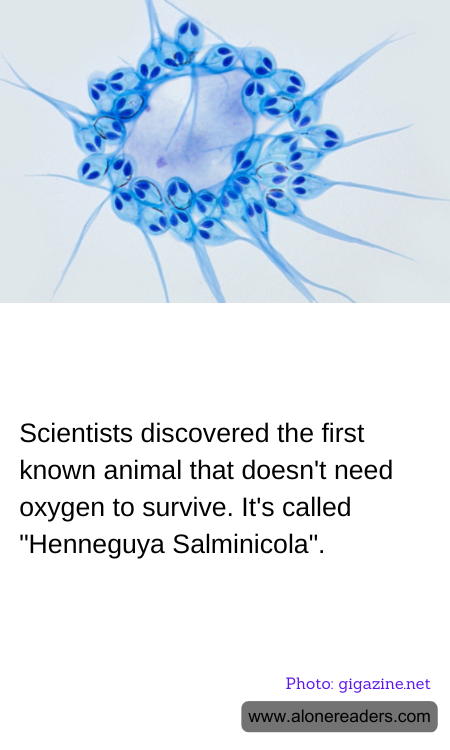
In a groundbreaking discovery, scientists have identified the first known animal that can survive without oxygen. This remarkable organism, Henneguya salminicola, is a tiny, parasitic creature that lives within the muscle tissue of salmon. Unlike other animals that rely on oxygen for survival, this unique species has adapted to thrive in an anaerobic environment, challenging our understanding of life and its requirements.
Henneguya salminicola belongs to the myxozoans, a group of microscopic parasites related to jellyfish and corals. These creatures are known for their simple structure and parasitic lifestyle, often infecting fish and other aquatic animals. What sets Henneguya salminicola apart is its lack of mitochondria, the organelles responsible for using oxygen to produce energy in most animal cells. Instead, this organism has evolved to obtain energy through other means, allowing it to survive in oxygen-deprived environments.
The discovery was made by a team of researchers from Tel Aviv University, who used advanced genomic sequencing techniques to study the DNA of Henneguya salminicola. They found that this organism lacks the genes necessary for aerobic respiration, the process by which most animals convert oxygen and nutrients into energy. This absence of mitochondrial DNA is unprecedented in the animal kingdom, making Henneguya salminicola a fascinating subject for further research.
The implications of this discovery are significant, as it challenges the long-held belief that oxygen is essential for all animal life. It opens up new possibilities for understanding how life can adapt to extreme conditions, such as those found in deep-sea environments or other planets. Moreover, it raises intriguing questions about the evolution of life on Earth and the potential for life forms that do not rely on oxygen.
Henneguya salminicola's ability to survive without oxygen also has practical implications. Understanding how this organism generates energy could lead to new insights into anaerobic processes, which might be applied in biotechnology and medicine. For instance, it could inspire novel approaches to treating diseases that involve oxygen deprivation or inform the development of new bioengineering techniques.
This discovery is a testament to the incredible diversity of life on Earth and the adaptability of organisms to their environments. It serves as a reminder that there is still much to learn about the natural world and the myriad ways life can exist. As scientists continue to explore the mysteries of life, Henneguya salminicola stands as a remarkable example of nature's ingenuity and resilience.