More About This Card
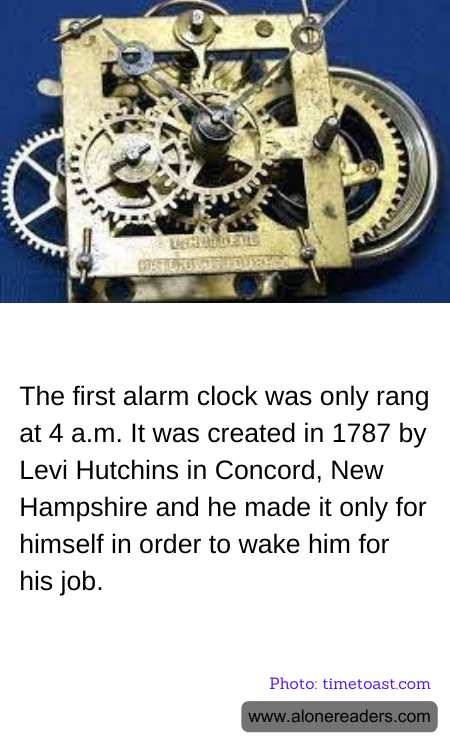
In the annals of history, the invention of the alarm clock stands as a testament to human ingenuity and the relentless pursuit of punctuality. The first known alarm clock, a simple yet revolutionary device, was crafted in 1787 by Levi Hutchins in Concord, New Hampshire. This invention was not born out of a desire to revolutionize timekeeping for the masses but rather to meet a personal need. Hutchins, a dedicated clockmaker, sought a reliable way to wake up at 4 a.m. to ensure he was on time for his job. Thus, he created a clock that would ring at this specific hour, marking the dawn of a new era in time management.
Levi Hutchins' creation was a singular piece, designed solely for his use. Unlike modern alarm clocks that offer a range of customizable settings, Hutchins' clock was rigid in its function. It was set to ring only at 4 a.m., reflecting the specific requirement of its creator. This limitation, however, did not diminish its significance. On the contrary, it highlighted the innovative spirit of the 18th century, where necessity often drove invention. Hutchins' alarm clock was a mechanical marvel of its time, utilizing gears and bells to produce a sound loud enough to rouse him from slumber.
The story of Levi Hutchins and his alarm clock is a fascinating glimpse into the past, illustrating how individual needs can lead to broader technological advancements. While Hutchins never sought to commercialize his invention, his work laid the groundwork for future developments in alarm clock technology. It wasn't until decades later that alarm clocks became widely available to the public, evolving into the versatile devices we use today. These modern iterations, with their snooze buttons and digital displays, owe a debt of gratitude to Hutchins' original creation.
Hutchins' alarm clock serves as a reminder of the timeless human quest for efficiency and productivity. It underscores the importance of time management, a concept that remains as relevant today as it was in the 18th century. The ability to wake up at a predetermined time is now taken for granted, yet it is rooted in the ingenuity of a man who simply wanted to be punctual for work. This small but significant invention has had a lasting impact, influencing the way we organize our lives and manage our time.
In reflecting on Levi Hutchins' contribution, we are reminded of the power of individual initiative and the far-reaching effects of seemingly modest inventions. His alarm clock, though created for personal use, symbolizes the broader human endeavor to harness technology for practical purposes. It is a testament to the enduring spirit of innovation that continues to shape our world, one tick at a time.