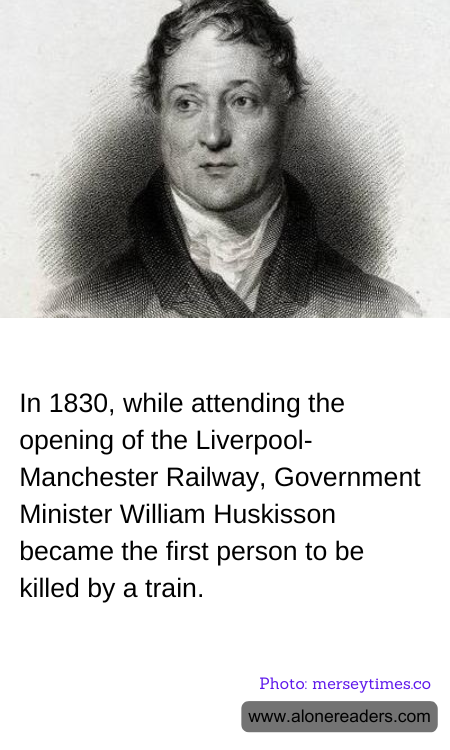
In the annals of transportation history, the year 1830 marks a significant milestone with the opening of the Liverpool-Manchester Railway, the world's first intercity railway line. This event was not only a triumph of engineering and industrial progress but also a day marked by tragedy. Among the distinguished guests attending the grand opening was William Huskisson, a prominent British statesman and Member of Parliament, who would become the first recorded casualty of a railway accident.
The Liverpool-Manchester Railway was a symbol of the burgeoning Industrial Revolution, promising to revolutionize travel and commerce. On September 15, 1830, a grand ceremony was held to celebrate its inauguration. The event attracted a host of dignitaries, including the Duke of Wellington, then Prime Minister, and William Huskisson, who was serving as the Member of Parliament for Liverpool. The day was filled with excitement and anticipation as the steam locomotive, Rocket, designed by George Stephenson, was set to showcase the future of transportation.
As the festivities unfolded, Huskisson, like many others, was eager to witness the marvel of the steam engine up close. During a stop at Parkside station, Huskisson disembarked from his carriage to greet the Duke of Wellington. In a moment of misjudgment, he found himself on the tracks as the Rocket approached. Despite attempts to warn him, Huskisson was unable to move to safety in time. The locomotive struck him, causing severe injuries. Despite immediate medical attention, Huskisson succumbed to his injuries later that day.
The tragic incident cast a shadow over what was meant to be a day of celebration. Huskisson's death was a stark reminder of the potential dangers associated with this new mode of transportation. It underscored the need for safety measures and regulations, which would become increasingly important as railways expanded across the globe. The accident prompted discussions about railway safety and the necessity of establishing protocols to protect passengers and workers alike.
William Huskisson's untimely death was a poignant moment in history, highlighting both the promise and peril of technological advancement. While the Liverpool-Manchester Railway continued to operate and pave the way for future railway developments, Huskisson's legacy endured as a cautionary tale. His story serves as a reminder of the human cost that can accompany progress and the importance of prioritizing safety alongside innovation.
Today, the tale of William Huskisson is often recounted as a footnote in the history of rail travel, a testament to the transformative power of the railway and the unforeseen consequences that can arise from technological breakthroughs. As we continue to push the boundaries of innovation, the lessons from that fateful day in 1830 remain relevant, urging us to balance ambition with caution in our pursuit of progress.
