More About This Card
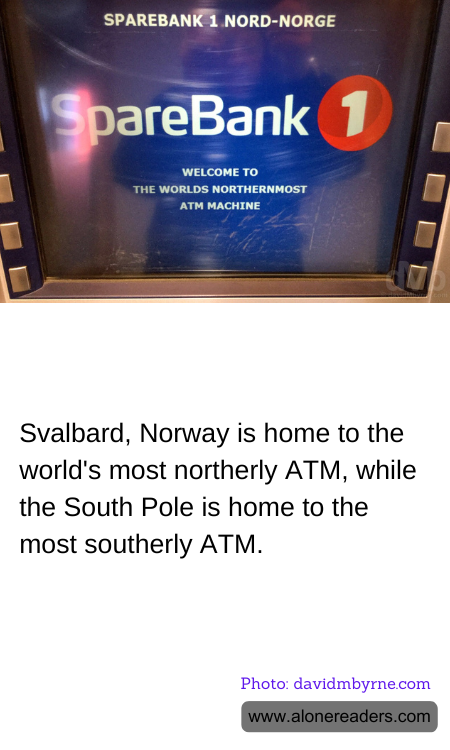
In the vast expanses of our planet, where the extremes of nature meet human ingenuity, there exist two remarkable outposts of modern convenience: the world's most northerly and southerly ATMs. These automated teller machines, located in Svalbard, Norway, and the South Pole, respectively, serve as fascinating symbols of human adaptation and the reach of technology.
Svalbard, an archipelago situated in the Arctic Ocean, is home to the northernmost ATM. This remote location, known for its stunning landscapes and polar bears, is part of Norway and lies about halfway between mainland Norway and the North Pole. The ATM in Svalbard is located in Longyearbyen, the largest settlement on the islands. Despite its remote location, Longyearbyen is a vibrant community with a university, research facilities, and a small but steady influx of tourists and scientists. The presence of an ATM here is a testament to the modern amenities that have reached even the most isolated parts of the world. It serves the local population and visitors, providing a crucial link to financial services in a place where cash is still a necessity for many transactions.
On the opposite end of the globe, the South Pole hosts the world's most southerly ATM. This machine is located at the Amundsen-Scott South Pole Station, a U.S. research facility that operates year-round. The station is a hub of scientific activity, with researchers studying everything from climate change to astronomy. The ATM at the South Pole is operated by Wells Fargo and is one of only two ATMs on the entire continent of Antarctica. It plays a vital role in supporting the daily needs of the station's personnel, who live and work in one of the most inhospitable environments on Earth. The presence of an ATM here underscores the importance of maintaining a semblance of normalcy and convenience, even in the most extreme conditions.
These ATMs are more than just machines; they are lifelines that connect remote communities to the global financial network. They highlight the adaptability of technology and the human spirit, ensuring that even in the farthest reaches of the Earth, people can access the services they need. The existence of these ATMs also reflects the growing interest in and accessibility of remote regions, driven by scientific exploration and tourism.
In a world where technology continues to shrink distances and bridge gaps, the ATMs in Svalbard and the South Pole stand as remarkable examples of how modern conveniences have permeated even the most isolated corners of our planet. They remind us that no matter how far we venture, the comforts of home are never truly out of reach.