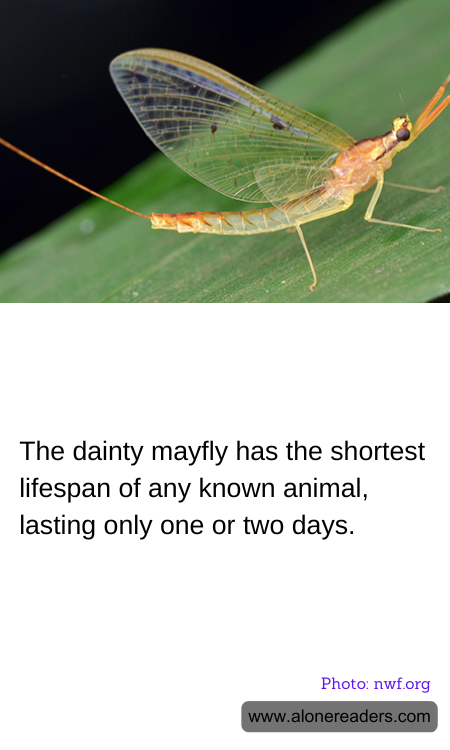
More About This Card
In the vast tapestry of life on Earth, the mayfly stands out as a remarkable example of nature's fleeting beauty. Known for having the shortest lifespan of any known animal, the mayfly's existence is a brief yet essential chapter in the story of our planet's ecosystems. Lasting only one or two days, the mayfly's life is a testament to the intricate balance of nature and the delicate dance of life and death.
Mayflies belong to the order Ephemeroptera, a name derived from the Greek word "ephemeros," meaning "short-lived." This aptly describes their adult phase, which is primarily dedicated to reproduction. Emerging from aquatic environments, mayflies spend the majority of their lives as nymphs underwater, where they can live for several months to a few years, depending on the species. During this time, they play a crucial role in the aquatic food web, serving as a food source for fish and other aquatic creatures.
When the time comes for the mayfly to transition into adulthood, it undergoes a dramatic transformation. The nymphs rise to the water's surface, shedding their exoskeletons to reveal delicate, winged adults. This emergence often occurs en masse, creating a mesmerizing spectacle as swarms of mayflies take to the air. Despite their short-lived adult phase, mayflies are equipped with two pairs of translucent wings and long, graceful tails that add to their ethereal appearance.
The primary purpose of the adult mayfly's brief existence is reproduction. With no functional mouthparts, adult mayflies do not eat; instead, they focus solely on mating. Males often form large swarms, performing intricate aerial dances to attract females. After mating, females lay their eggs on the water's surface, ensuring the continuation of the species. Once this task is complete, the adult mayflies quickly succumb to exhaustion and die, their bodies often forming a carpet on the ground or water.
Despite their ephemeral nature, mayflies play a vital role in their ecosystems. They are an important food source for a variety of animals, including birds, bats, and fish. Additionally, their presence is an indicator of a healthy aquatic environment, as they are sensitive to pollution and changes in water quality. The life cycle of the mayfly, from nymph to adult, is a reminder of the interconnectedness of life and the importance of preserving natural habitats.
The mayfly's brief yet impactful existence serves as a poignant reminder of the beauty and transience of life. While their time on Earth is short, mayflies contribute significantly to the ecological balance, highlighting the importance of every creature, no matter how small or short-lived. In celebrating the mayfly, we are reminded to appreciate the fleeting moments of beauty in our own lives and the intricate web of life that sustains us all.