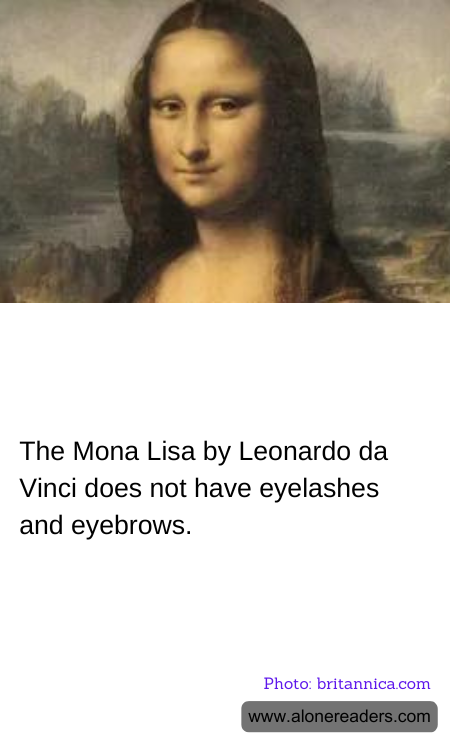
Leonardo da Vinci's "Mona Lisa" is arguably one of the most famous paintings in the world, captivating audiences with her enigmatic smile and mysterious gaze. However, one often overlooked detail is that the Mona Lisa lacks both eyelashes and eyebrows. This peculiar absence has intrigued art historians and enthusiasts alike, sparking numerous theories and discussions about da Vinci's intentions and techniques.
The absence of eyelashes and eyebrows in the Mona Lisa is not immediately noticeable, as the painting's allure often draws viewers to her smile and eyes. However, upon closer inspection, the lack of these facial features becomes apparent. Some art historians suggest that this omission was intentional, aligning with da Vinci's pursuit of ideal beauty. During the Renaissance, artists often depicted women with minimal facial hair to emphasize smooth, unblemished skin, which was considered a hallmark of beauty at the time. By omitting eyelashes and eyebrows, da Vinci might have been adhering to this aesthetic ideal, focusing instead on the subtlety and depth of expression in her eyes and smile.
Another theory posits that the absence of these features could be due to the passage of time and the painting's preservation. Over the centuries, the Mona Lisa has undergone various restoration efforts, and it is possible that the delicate pigments used for the eyelashes and eyebrows have faded or been inadvertently removed. The painting's varnish, which has yellowed over time, might also obscure these finer details, leading to their apparent absence. This theory is supported by the fact that other paintings from the same period have experienced similar issues with fading and pigment loss.
Technological advancements have allowed researchers to examine the Mona Lisa in unprecedented detail. Infrared scans and high-resolution photography have revealed traces of what might have been eyelashes and eyebrows, suggesting that da Vinci initially included them in his composition. These findings indicate that the Mona Lisa's current appearance might not fully represent da Vinci's original vision, highlighting the challenges of preserving such an iconic work of art.
Regardless of the reason behind the missing eyelashes and eyebrows, the Mona Lisa continues to captivate audiences with her timeless beauty and mystery. Her gaze, seemingly following viewers around the room, and her subtle smile have inspired countless interpretations and debates. The absence of these facial features only adds to the painting's allure, inviting viewers to ponder the intentions of the master artist and the secrets that the Mona Lisa might hold.
In the end, whether the lack of eyelashes and eyebrows was a deliberate choice by da Vinci or a consequence of time, it remains a fascinating aspect of this masterpiece. The Mona Lisa's enduring appeal lies not only in her beauty but also in the mysteries that surround her, ensuring that she remains a subject of intrigue and admiration for generations to come.
