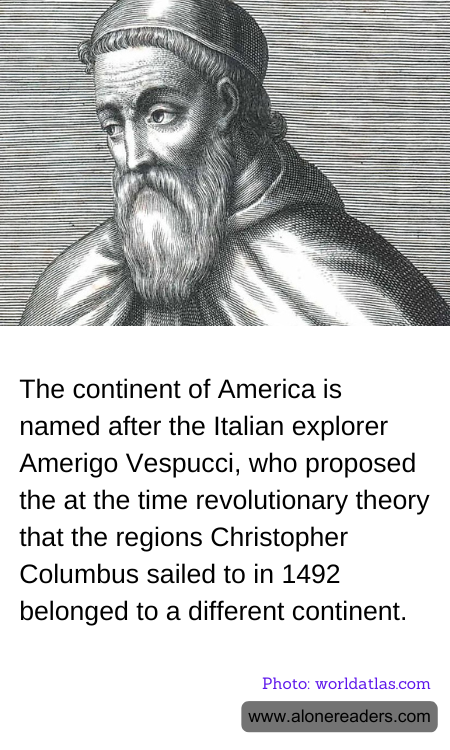
The continent of America owes its name to the Italian explorer Amerigo Vespucci, a figure whose contributions to the Age of Exploration were both profound and transformative. While Christopher Columbus is often credited with discovering the New World in 1492, it was Vespucci who proposed the groundbreaking theory that these newly encountered lands were not part of Asia, as Columbus had believed, but rather an entirely separate continent. This revelation would forever change the understanding of the world's geography.
Amerigo Vespucci was born in Florence, Italy, in 1454, and his early career was marked by a keen interest in navigation and exploration. He embarked on several voyages to the New World in the late 15th and early 16th centuries, during which he meticulously documented his observations. Unlike Columbus, who remained convinced that he had reached the outskirts of Asia, Vespucci's careful study of the geography, flora, and fauna led him to a different conclusion. He realized that the lands he explored were part of a vast, uncharted continent, distinct from the known continents of Europe, Asia, and Africa.
Vespucci's insights were revolutionary at the time, challenging the prevailing geographical understanding. His letters and accounts of his voyages were widely circulated and read by scholars and cartographers across Europe. In 1507, a German cartographer named Martin Waldseemüller published a world map that included the new continent, which he named "America" in Vespucci's honor. Waldseemüller believed that Vespucci was the first to recognize the New World as a separate continent, and thus, he deserved the recognition.
The naming of America after Vespucci was not without controversy. Some contemporaries of Vespucci and later historians debated the fairness of naming the continent after him, given that Columbus had reached the New World first. However, Vespucci's contributions to the understanding of the New World's geography were undeniable, and his name became indelibly linked to the continent.
Today, Amerigo Vespucci is remembered as a pioneering explorer whose insights helped shape the modern understanding of the world's geography. His recognition of the Americas as a separate continent was a pivotal moment in history, paving the way for further exploration and colonization. The name "America" serves as a lasting tribute to his legacy, a reminder of the power of exploration and the enduring impact of those who dare to challenge the status quo. As we reflect on the history of exploration, Vespucci's story stands as a testament to the spirit of discovery and the quest for knowledge that continues to drive humanity forward.
