More About This Card
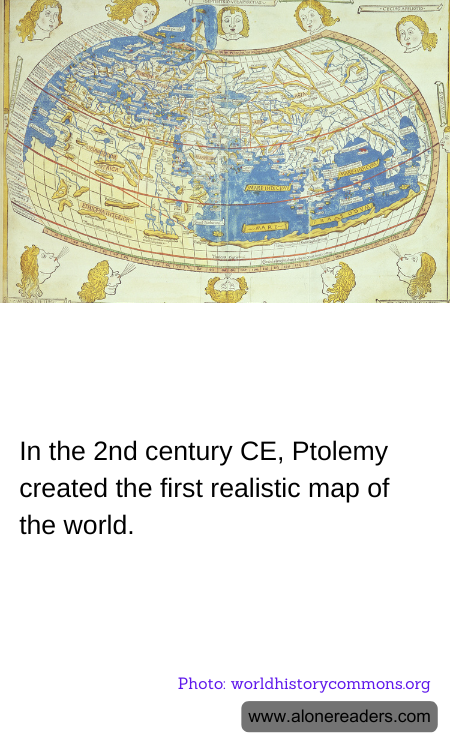
In the 2nd century CE, the world witnessed a remarkable leap in the field of cartography, thanks to the pioneering work of Claudius Ptolemy. A Greco-Egyptian scholar based in Alexandria, Ptolemy was a polymath whose contributions spanned astronomy, mathematics, and geography. Among his most enduring legacies is the creation of what is often regarded as the first realistic map of the world, a feat that significantly influenced the way people understood the Earth's geography for centuries.
Ptolemy's map was part of his seminal work, the "Geographia," a comprehensive treatise that compiled the geographical knowledge of the Roman Empire and beyond. Unlike earlier maps, which were often based on myth and speculation, Ptolemy's map was grounded in empirical observation and mathematical precision. He introduced the concept of using a grid system of latitude and longitude to pinpoint locations, a revolutionary idea that laid the groundwork for modern cartography. This system allowed for a more accurate representation of the world, enabling travelers and scholars to navigate with greater confidence.
The map itself was a remarkable synthesis of the knowledge available at the time. Ptolemy drew upon the accounts of explorers, traders, and military campaigns to piece together a coherent picture of the world. His map included Europe, parts of Asia, and the northern reaches of Africa, reflecting the extent of the Roman Empire's influence and the known world of his era. While some inaccuracies were inevitable due to the limited information available, Ptolemy's work was a significant improvement over previous attempts, which often depicted fantastical creatures and lands.
Ptolemy's influence extended far beyond his own time. His "Geographia" was rediscovered in the Middle Ages and became a cornerstone of Renaissance cartography. The map was translated into Latin and widely disseminated, inspiring explorers like Christopher Columbus and Vasco da Gama to embark on their voyages of discovery. Even though Ptolemy's map was eventually superseded by more accurate representations, its impact on the development of geographical science cannot be overstated.
In essence, Ptolemy's creation of the first realistic map of the world was a milestone in human understanding of the planet. It marked a shift from mythological interpretations to a more scientific approach, paving the way for future advancements in geography and exploration. Ptolemy's legacy endures not only in the maps that followed but also in the spirit of inquiry and discovery that continues to drive our quest to understand the world around us.