More About This Card
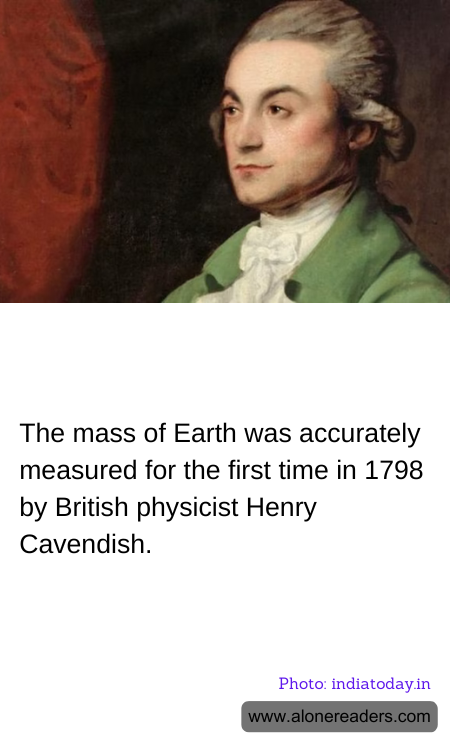
In the realm of scientific discovery, few achievements stand as monumental as the first accurate measurement of Earth's mass. This groundbreaking feat was accomplished in 1798 by the British physicist Henry Cavendish, whose meticulous work laid the foundation for modern gravitational studies. Cavendish's experiment not only provided a deeper understanding of our planet but also marked a significant milestone in the field of physics.
Henry Cavendish, a reclusive yet brilliant scientist, embarked on this ambitious project with the aim of determining the density of the Earth. To achieve this, he ingeniously adapted an apparatus known as the torsion balance, originally devised by the geologist John Michell. The device consisted of a horizontal bar suspended from a thin wire, with small lead spheres attached to each end. Larger lead spheres were placed nearby, and the gravitational attraction between the small and large spheres caused the bar to twist. By measuring the angle of this twist, Cavendish could calculate the force of attraction and, consequently, the density of the Earth.
The precision of Cavendish's experiment was remarkable for its time. He meticulously accounted for various factors that could affect the results, such as air currents and temperature fluctuations. His calculations revealed that the Earth's density was approximately 5.48 times that of water, which allowed him to estimate the Earth's mass with unprecedented accuracy. This was a pivotal moment in science, as it provided the first reliable figure for the mass of our planet, a fundamental constant that would be crucial for future studies in astronomy and physics.
Cavendish's work was not just a triumph of scientific ingenuity but also a testament to the power of careful observation and experimentation. His findings were published in the Philosophical Transactions of the Royal Society, where they garnered significant attention and acclaim. The experiment, often referred to as "weighing the Earth," demonstrated the universal applicability of Newton's law of gravitation and underscored the interconnectedness of celestial and terrestrial phenomena.
The legacy of Henry Cavendish's experiment extends far beyond its immediate impact. It paved the way for subsequent advancements in geophysics and cosmology, influencing the work of later scientists such as Charles Darwin and Albert Einstein. Today, the principles underlying Cavendish's experiment continue to inform our understanding of gravitational forces and the structure of the universe.
In reflecting on Cavendish's achievement, one is reminded of the profound curiosity and determination that drive scientific exploration. His ability to measure the seemingly immeasurable serves as an enduring inspiration, illustrating the power of human ingenuity to unlock the mysteries of the natural world. As we continue to explore the cosmos and our place within it, the pioneering spirit of Henry Cavendish remains a guiding light, encouraging us to look beyond the horizon and seek answers to the questions that define our existence.