More About This Card
On the night of September 23–24, 1846, a remarkable discovery unfolded in the realm of astronomy that would forever change our understanding of the solar system. Astronomers Johann Galle and Heinrich d'Arrest, working at the Berlin Observatory, identified Neptune, the eighth planet orbiting the Sun. This discovery was not just a triumph of observational astronomy but also a testament to the power of mathematical prediction.
The journey to Neptune's discovery began with the peculiarities observed in the orbit of Uranus, the seventh planet from the Sun. Astronomers noticed that Uranus did not follow its predicted path, suggesting the gravitational influence of an unseen celestial body. This anomaly piqued the interest of mathematicians and astronomers alike. Among them was the French mathematician Urbain Le Verrier, who meticulously calculated the position of this potential new planet using the perturbations in Uranus's orbit as a guide.
Le Verrier's calculations were sent to Johann Galle at the Berlin Observatory. On the night of September 23, 1846, Galle, assisted by d'Arrest, pointed their telescope to the region of the sky indicated by Le Verrier. To their amazement, they found Neptune almost exactly where Le Verrier had predicted. This discovery was a monumental achievement, marking the first time a planet was located through mathematical prediction rather than direct observation.
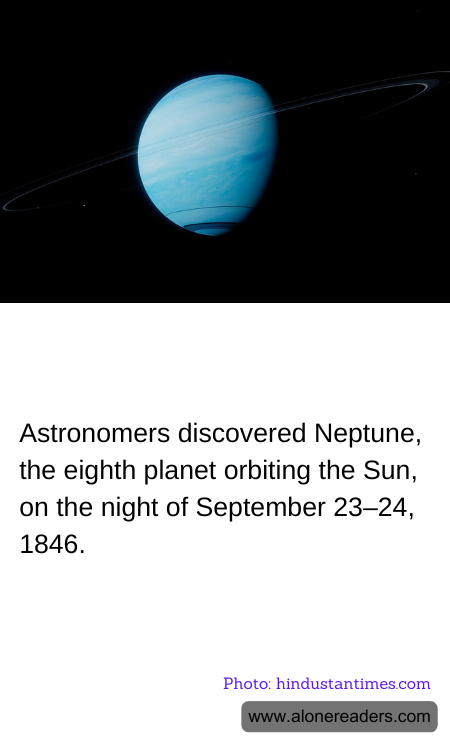
Neptune, named after the Roman god of the sea, is a gas giant similar in composition to Uranus. It is characterized by its striking blue color, a result of methane in its atmosphere absorbing red light and reflecting blue. Neptune's discovery expanded our understanding of the solar system, revealing the vastness and complexity of the celestial neighborhood we inhabit.
The identification of Neptune also underscored the collaborative nature of scientific discovery. While Le Verrier's calculations were crucial, the observations made by Galle and d'Arrest were equally important. This teamwork across borders and disciplines exemplified the spirit of scientific inquiry and the relentless pursuit of knowledge.
Today, Neptune continues to intrigue astronomers and space enthusiasts alike. Its dynamic atmosphere, with the fastest winds in the solar system, and its intriguing moons, such as Triton, offer endless opportunities for exploration and study. The discovery of Neptune not only added a new member to our planetary family but also demonstrated the profound impact of human curiosity and ingenuity in unraveling the mysteries of the universe.
As we look back on that historic night in 1846, we are reminded of the power of observation, the importance of collaboration, and the endless possibilities that lie beyond our current understanding. Neptune's discovery remains a shining example of how science can illuminate the unknown and inspire future generations to reach for the stars.