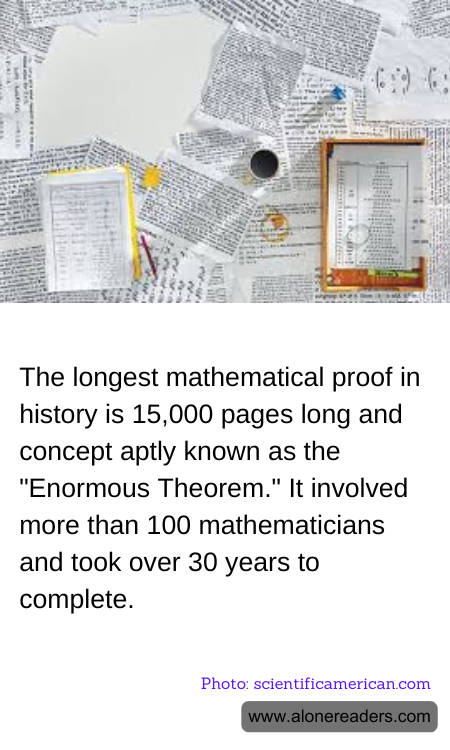
In the world of mathematics, where precision and brevity often reign supreme, the "Enormous Theorem" stands as a monumental exception. This colossal mathematical proof, stretching over an astounding 15,000 pages, is not only the longest in history but also a testament to human collaboration and perseverance. The theorem, which took more than 30 years to complete, involved the collective efforts of over 100 mathematicians from around the globe, each contributing their expertise to solve a problem of immense complexity.
The journey to the Enormous Theorem began with an ambitious goal: to classify all finite simple groups. These groups are fundamental building blocks in the field of group theory, akin to prime numbers in number theory. Understanding them is crucial for various applications in mathematics and beyond, including cryptography and theoretical physics. The classification of finite simple groups was a problem that had tantalized mathematicians for decades, and its resolution required a Herculean effort.
The collaborative nature of this project is one of its most remarkable aspects. Mathematicians from different countries, backgrounds, and areas of expertise came together, each tackling different parts of the problem. This international cooperation was essential, as the complexity of the theorem meant that no single mathematician could have possibly completed it alone. The work was divided into numerous smaller theorems and lemmas, each meticulously proven and then pieced together like a vast jigsaw puzzle.
Despite its daunting length, the Enormous Theorem is not just a feat of endurance but also a triumph of mathematical ingenuity. The proof required the development of new mathematical techniques and concepts, pushing the boundaries of what was previously thought possible. It also highlighted the importance of communication and collaboration in the scientific community, as mathematicians shared ideas and built upon each other's work.
The completion of the Enormous Theorem is a landmark achievement in mathematics, demonstrating the power of human intellect and the potential of collaborative effort. It serves as an inspiration to future generations of mathematicians, showing that even the most formidable challenges can be overcome with dedication and teamwork. While the sheer size of the proof may seem overwhelming, its existence is a reminder of the beauty and complexity of mathematics, a field where the pursuit of knowledge knows no bounds.
In an era where technology often takes center stage, the Enormous Theorem is a testament to the enduring value of human curiosity and the relentless quest for understanding. It stands as a monument to the collaborative spirit of the mathematical community and a beacon of what can be achieved when minds come together to tackle the seemingly impossible.
