More About This Card
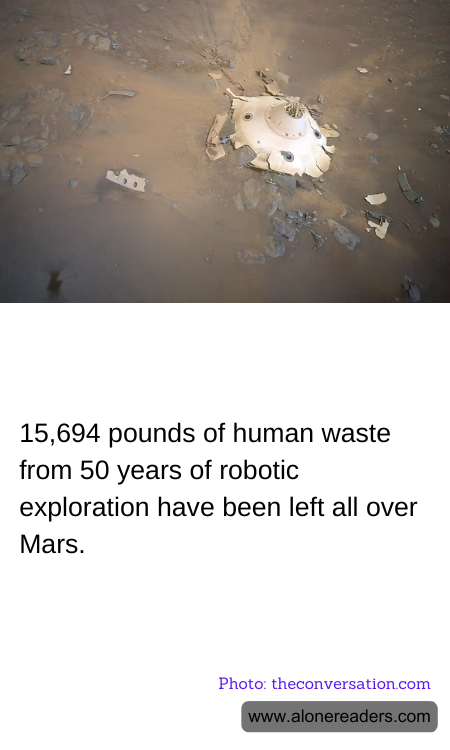
For over half a century, humanity has been reaching out to the cosmos, with Mars being one of our most intriguing destinations. The Red Planet has been the focus of numerous robotic missions, each contributing to our understanding of its environment, geology, and potential for life. However, these missions have also left behind an unintended legacy: approximately 15,694 pounds of human waste scattered across the Martian landscape.
This accumulation of debris is the result of over 50 years of exploration, beginning with the Soviet Union's Mars 3 mission in 1971, which was the first to land a spacecraft on Mars. Since then, various countries have launched a series of orbiters, landers, and rovers, each leaving behind remnants of their journey. These include discarded landing gear, parachutes, heat shields, and even defunct spacecraft that have completed their missions. While these remnants are a testament to human ingenuity and our quest for knowledge, they also pose a challenge for future exploration.
The presence of this waste raises several concerns. Firstly, there is the issue of contamination. Mars is a pristine environment, and scientists are keen to avoid introducing Earth-based microbes that could potentially interfere with the search for Martian life. Although spacecraft are sterilized before launch, the debris left behind could still harbor microorganisms that survived the journey. This contamination could complicate future missions aimed at detecting signs of life, as distinguishing between Earth-originating and Martian life forms becomes more challenging.
Moreover, the accumulation of waste on Mars presents logistical challenges for future missions. As we plan for human exploration and potential colonization, the need to manage and mitigate debris becomes increasingly important. Navigating around these obstacles could complicate landing procedures and pose risks to new missions. Additionally, the presence of waste could impact the aesthetic and scientific value of the Martian landscape, which is an important consideration for both researchers and the public.
Efforts are underway to address these concerns. Space agencies are exploring ways to minimize waste production in future missions, such as designing spacecraft components that can be repurposed or recycled. There is also ongoing research into developing technologies that could retrieve or repurpose existing debris. These initiatives are crucial as we look towards a future where Mars could become a more permanent outpost for human activity.
In conclusion, while the 15,694 pounds of waste left on Mars is a byproduct of our relentless pursuit of knowledge, it also serves as a reminder of the responsibilities that come with exploration. As we continue to reach for the stars, it is imperative that we do so with an eye towards sustainability, ensuring that our quest for discovery does not come at the expense of the environments we seek to understand.