More About This Card
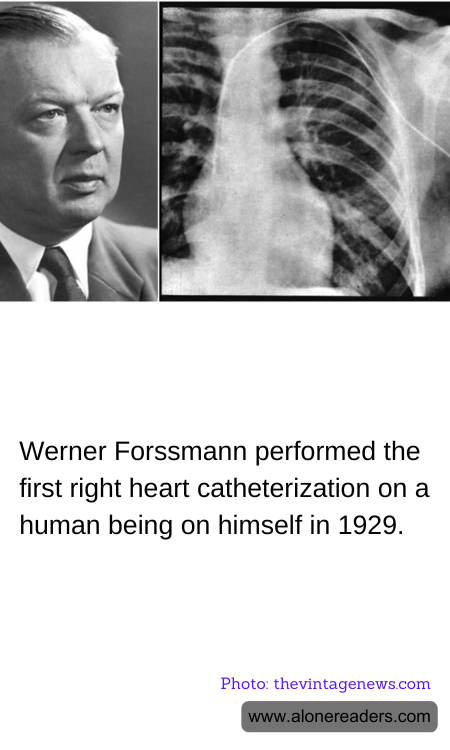
In the annals of medical history, few stories are as daring and groundbreaking as that of Werner Forssmann, a young German physician whose audacious self-experimentation in 1929 paved the way for modern cardiology. At a time when the inner workings of the human heart were largely a mystery, Forssmann's pioneering spirit and unyielding curiosity led him to perform the first right heart catheterization on a human being—himself.
Werner Forssmann was born in Berlin in 1904 and pursued a career in medicine, eventually becoming a surgical resident at a small hospital in Eberswalde, Germany. It was here that Forssmann became fascinated with the idea of accessing the heart from within, a concept that was met with skepticism and resistance from his peers and superiors. At the time, the heart was considered untouchable, and any invasive procedure was deemed too dangerous. However, Forssmann was undeterred by these warnings and was determined to explore the possibilities of cardiac catheterization.
In a bold move that would forever change the landscape of cardiology, Forssmann decided to conduct the experiment on himself. With the assistance of a nurse, who was initially unaware of his true intentions, he inserted a thin catheter into his own antecubital vein, threading it carefully through his arm and into his heart. To document this unprecedented procedure, Forssmann walked to the hospital's X-ray department, where he captured the catheter's position within his heart on film. This remarkable feat demonstrated that it was possible to safely access the heart's chambers, opening the door to a new era of diagnostic and therapeutic techniques.
Forssmann's self-experimentation was initially met with disbelief and criticism from the medical community. Many regarded his actions as reckless and unprofessional, and he faced significant professional setbacks as a result. However, his work eventually gained recognition and inspired further research in the field. Over time, cardiac catheterization became an invaluable tool in diagnosing and treating heart conditions, leading to significant advancements in cardiovascular medicine.
In 1956, Werner Forssmann's contributions were finally acknowledged when he was awarded the Nobel Prize in Physiology or Medicine, alongside André Cournand and Dickinson W. Richards, who further developed and refined the technique. Forssmann's story is a testament to the power of innovation and the courage to challenge established norms. His willingness to take risks and push the boundaries of medical science has saved countless lives and continues to influence the field of cardiology to this day.
Werner Forssmann's legacy is a reminder of the importance of perseverance and curiosity in the pursuit of knowledge. His groundbreaking work not only transformed our understanding of the human heart but also exemplified the spirit of scientific inquiry that drives medical progress. Today, cardiac catheterization is a routine procedure, thanks to the daring vision of a young doctor who dared to explore the unknown.