More About This Card
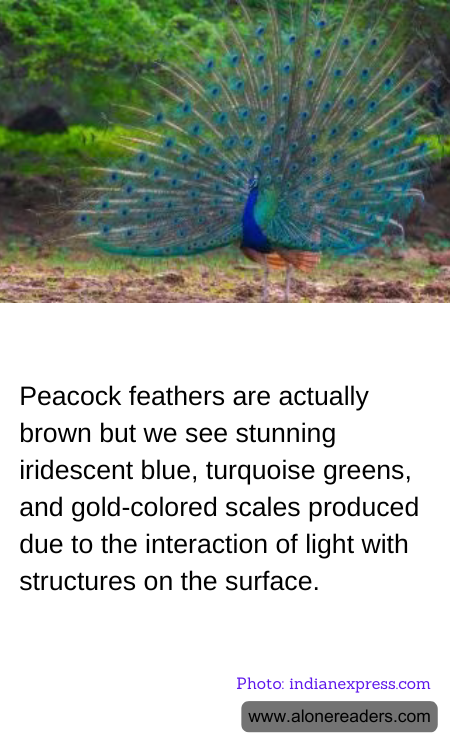
The peacock, with its resplendent display of vibrant colors, has long fascinated humans and inspired countless works of art and literature. However, the secret behind its stunning plumage lies not in the pigments of its feathers but in the intricate play of light and structure. Despite appearances, peacock feathers are actually brown. The dazzling blues, greens, and golds that captivate our eyes are the result of a phenomenon known as structural coloration.
Structural coloration occurs when microscopic structures on the surface of the feathers interact with light. In the case of the peacock, these structures are composed of tiny, plate-like formations that reflect and refract light in such a way that certain wavelengths are amplified while others are diminished. This interaction creates the iridescent effect that makes the peacock's feathers appear to shimmer and change color depending on the angle of light and the viewer's perspective.
The science behind this optical illusion is rooted in the principles of physics. When light strikes the feather, it encounters layers of keratin and air. These layers are arranged in a precise pattern that causes light waves to interfere with one another. Some wavelengths are reinforced, producing the vivid colors we see, while others are canceled out. This process is similar to the way a soap bubble displays a rainbow of colors on its surface.
The evolutionary advantage of such a display is significant. For peacocks, the vibrant plumage serves as a crucial tool in attracting mates. The more brilliant and varied the colors, the more likely a peacock is to catch the eye of a potential partner. This has led to the development of increasingly complex feather structures over generations, driven by the pressures of sexual selection.
Beyond their role in courtship, peacock feathers have also captured the imagination of humans for centuries. They have been used in fashion, art, and decoration, symbolizing beauty, pride, and immortality in various cultures. The peacock's ability to transform simple brown feathers into a kaleidoscope of colors is a testament to the wonders of nature and the intricate interplay of light and matter.
In conclusion, the peacock's feathers are a remarkable example of how nature can use simple materials to create extraordinary effects. Through the science of structural coloration, these birds have evolved a way to turn the mundane into the magnificent, captivating both their fellow creatures and humans alike. As we continue to study and appreciate these natural wonders, we gain a deeper understanding of the complex and beautiful world we inhabit.