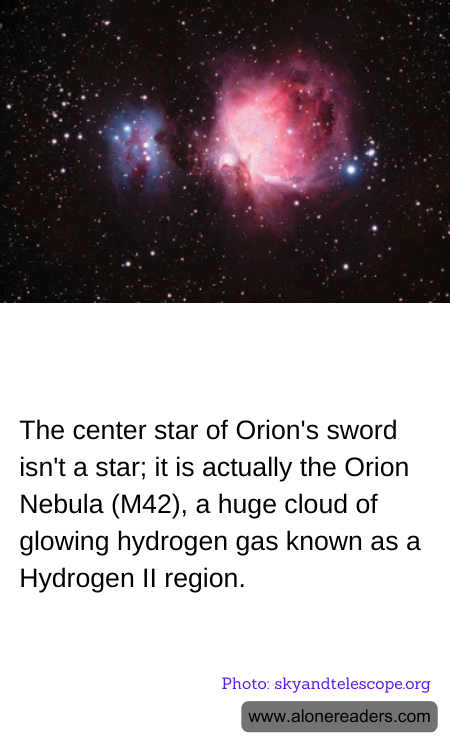
In the vast tapestry of the night sky, the constellation of Orion stands out as one of the most recognizable and storied formations. Often referred to as "The Hunter," Orion is a celestial beacon that has guided sailors, inspired myths, and fascinated stargazers for centuries. Among its many intriguing features is Orion's sword, which appears to hang from the hunter's belt. While most observers might assume that the bright points within this sword are stars, the center "star" is, in fact, something far more extraordinary: the Orion Nebula, also known as Messier 42 (M42).
The Orion Nebula is a breathtaking spectacle, a massive cloud of glowing hydrogen gas that stretches across 24 light-years. It is classified as a Hydrogen II region, a type of nebula where hydrogen gas is ionized by the intense radiation from nearby young stars. This ionization causes the gas to emit light, creating a luminous and colorful display that can be seen even with the naked eye under dark skies. The nebula's vibrant hues and intricate structures make it a favorite target for both amateur and professional astronomers.
Located approximately 1,344 light-years from Earth, the Orion Nebula is one of the closest regions of massive star formation to our planet. It serves as a stellar nursery, where new stars are born from the dense clouds of gas and dust. Within this cosmic cradle, astronomers have identified hundreds of young stars, many of which are still in the early stages of development. The nebula's dynamic environment provides a unique opportunity to study the processes that lead to star formation and the evolution of planetary systems.
The Orion Nebula's significance extends beyond its beauty and scientific interest. It offers a glimpse into the past, revealing the conditions that likely existed in our own solar system's formative years. By studying the nebula, scientists can gain insights into the origins of stars and planets, helping to unravel the mysteries of our cosmic heritage.
For those who wish to observe the Orion Nebula, it is best viewed during the winter months in the Northern Hemisphere, when Orion dominates the night sky. A small telescope or even a pair of binoculars can reveal the nebula's glowing heart and its surrounding stars, providing a window into the wonders of the universe.
In conclusion, the center "star" of Orion's sword is not a star at all, but the magnificent Orion Nebula. This celestial marvel is a testament to the beauty and complexity of the cosmos, inviting us to explore and appreciate the universe's boundless mysteries. Whether you are a seasoned astronomer or a curious observer, the Orion Nebula offers a captivating glimpse into the heart of star formation, reminding us of the endless wonders that lie beyond our world.
