More About This Card
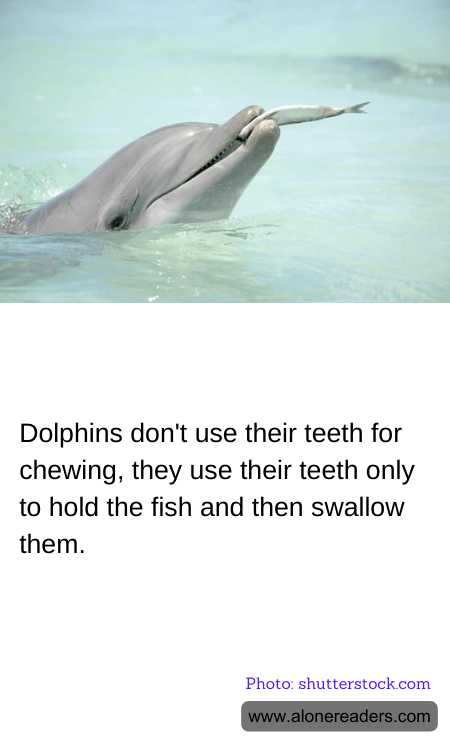
Dolphins are among the most fascinating creatures in the ocean, captivating the hearts and minds of people worldwide with their intelligence and playful nature. One of the lesser-known facts about these marine mammals is their unique approach to eating. Unlike humans and many other animals, dolphins do not use their teeth for chewing. Instead, they employ their teeth primarily for grasping and holding onto their prey, which they then swallow whole.
This intriguing feeding behavior is largely due to the structure of a dolphin's mouth and digestive system. Dolphins have conical-shaped teeth that are perfectly adapted for catching slippery fish and squid. These teeth interlock when the dolphin closes its mouth, creating a secure grip on its prey. Once caught, the dolphin will often toss the fish into the air or shake its head to position the prey head-first before swallowing it. This method ensures that the fish's fins do not get caught in the dolphin's throat, allowing for a smooth passage down the esophagus.
The reason dolphins do not chew their food is linked to their evolutionary adaptations. Chewing is not necessary for dolphins because their digestive systems are highly efficient at breaking down whole prey. The stomach of a dolphin is divided into multiple chambers, each with a specific role in digestion. The first chamber, known as the forestomach, is responsible for storing and softening the food. The subsequent chambers further break down the food with the help of digestive enzymes, ensuring that the nutrients are fully absorbed.
This method of feeding is not only efficient but also energy-saving. By swallowing their prey whole, dolphins can quickly consume their meals and spend more time hunting or engaging in social activities. This is particularly important for dolphins, as they are highly social animals that live in pods and rely on cooperation and communication for survival.
Moreover, the ability to swallow prey whole allows dolphins to take advantage of the abundant food resources in their environment. They can consume a wide variety of fish and squid, adapting their diet based on availability. This dietary flexibility is crucial for their survival, especially in changing oceanic conditions.
In conclusion, the way dolphins use their teeth highlights the remarkable adaptations these creatures have developed to thrive in their aquatic habitats. By using their teeth solely for gripping and swallowing their prey whole, dolphins demonstrate an efficient and effective feeding strategy that supports their active and social lifestyles. This fascinating aspect of dolphin biology not only underscores their uniqueness but also adds to the wonder and admiration we hold for these intelligent marine mammals.