More About This Card
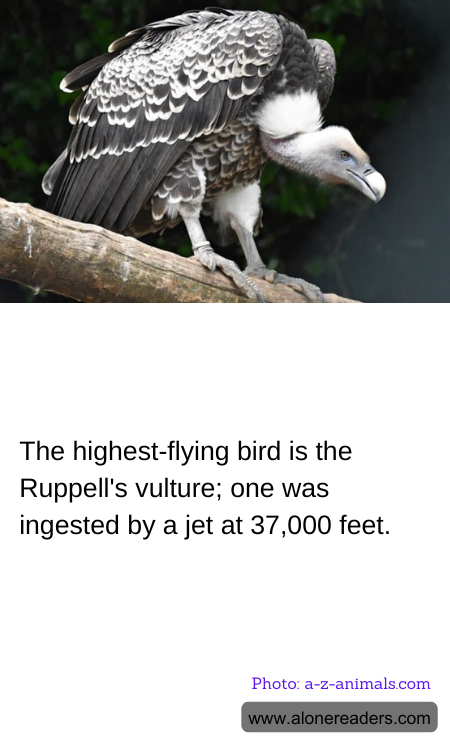
In the vast expanse of the sky, where few creatures dare to venture, the Rüppell's vulture holds a remarkable record. Known for its incredible flying capabilities, this bird has been documented soaring at altitudes that most other avian species can only dream of reaching. The Rüppell's vulture, native to the Sahel region of central Africa, has been recorded flying at an astonishing height of 37,000 feet. This altitude is not just a testament to the bird's extraordinary adaptation to its environment but also a record that places it at the pinnacle of avian flight.
The Rüppell's vulture's high-altitude flight was famously documented in a rather unusual incident. In 1973, a Rüppell's vulture collided with a commercial aircraft over the Ivory Coast. The bird was ingested by the jet's engine at an altitude of 37,000 feet, a height that is typically reserved for long-haul flights of modern airliners. This incident not only highlighted the bird's incredible flying prowess but also brought attention to the unique challenges faced by wildlife in sharing airspace with human technology.
Rüppell's vultures have evolved several physiological adaptations that enable them to thrive at such high altitudes. Their hemoglobin has a unique structure that allows for efficient oxygen uptake even in the thin air of the upper atmosphere. This adaptation is crucial, as oxygen levels at 37,000 feet are significantly lower than at sea level. Additionally, their large wingspan, which can reach up to 8.5 feet, allows them to glide effortlessly on thermal currents, conserving energy during long flights.
Despite their impressive capabilities, Rüppell's vultures face numerous threats in the modern world. Habitat loss, poisoning, and collisions with power lines have contributed to a decline in their population. Conservation efforts are underway to protect these magnificent birds and ensure that they continue to grace the skies with their presence. Organizations are working to mitigate the risks posed by human activities and to preserve the natural habitats that are crucial for their survival.
The story of the Rüppell's vulture serves as a reminder of the wonders of the natural world and the delicate balance that exists between wildlife and human advancement. As we continue to explore and expand our technological capabilities, it is essential to consider the impact on the creatures that share our planet. The Rüppell's vulture, with its record-breaking flights, inspires awe and respect for the resilience and adaptability of nature. By fostering a deeper understanding and appreciation of these remarkable birds, we can work towards a future where both humans and wildlife can coexist harmoniously in the skies.