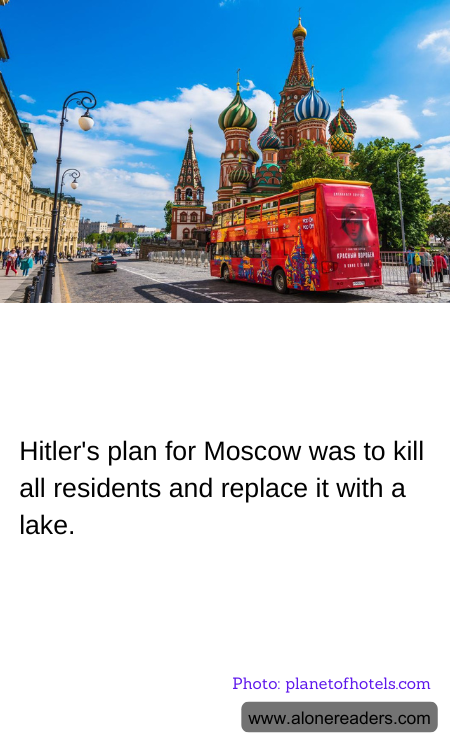
During the tumultuous years of World War II, Adolf Hitler's ambitions extended far beyond mere military conquest. Among his most chilling plans was the proposed fate of Moscow, the heart of the Soviet Union. Hitler's vision for Moscow was not just to capture the city but to obliterate it entirely, eradicating its population and transforming the area into a vast lake. This plan, though never realized, underscores the extreme measures Hitler was willing to consider in his quest for dominance.
The idea of turning Moscow into a lake was part of a broader strategy known as Generalplan Ost, which aimed to reshape Eastern Europe according to Nazi ideology. This plan involved the systematic depopulation of vast areas, making room for German settlers and ensuring the long-term supremacy of the Aryan race. Moscow, as the capital of the Soviet Union, symbolized a significant ideological and strategic target. Hitler's plan to destroy the city and its inhabitants was not only a military objective but also a symbolic act intended to crush Soviet morale and resistance.
The proposed transformation of Moscow into a lake involved the use of explosives to breach the Moscow-Volga Canal, flooding the city and its surroundings. This drastic measure was intended to eliminate any possibility of the city's recovery and to serve as a stark warning to other Soviet territories. The plan reflected the extreme lengths to which Hitler was prepared to go to achieve his vision of a new world order, one in which entire populations could be erased to make way for his ideological goals.
Fortunately, Hitler's plan for Moscow never came to fruition. The resilience of the Soviet forces, combined with the harsh Russian winter and logistical challenges, thwarted the German advance. The Battle of Moscow, which took place between October 1941 and January 1942, marked a turning point in the war. The Soviet defense not only saved the city but also dealt a significant blow to the German military, demonstrating that Hitler's ambitions were not invincible.
The notion of transforming Moscow into a lake remains a haunting reminder of the destructive potential of unchecked power and ideology. It serves as a stark example of how far-reaching and devastating the consequences of totalitarian ambitions can be. While the plan was never executed, its existence highlights the importance of vigilance and resistance in the face of tyranny. As history continues to unfold, the lessons from this dark chapter remind us of the value of human life and the enduring strength of those who stand against oppression.
