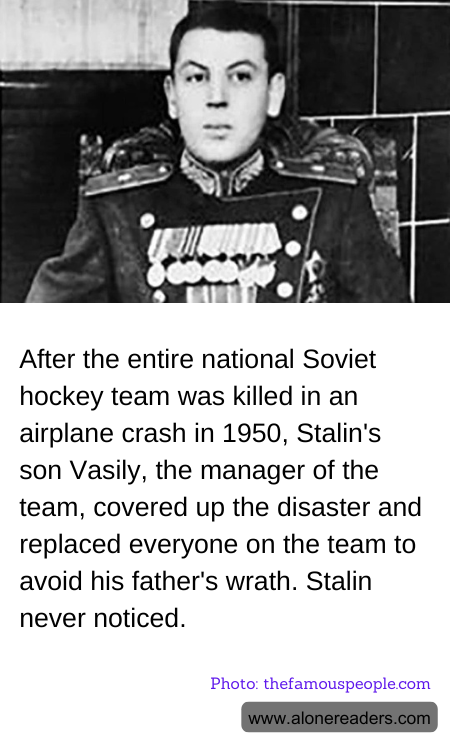
In the annals of sports history, few tales are as shrouded in mystery and intrigue as the story of the Soviet national hockey team in 1950. This narrative, steeped in the shadows of Cold War secrecy, revolves around a tragic airplane crash that claimed the lives of the entire team and the subsequent cover-up orchestrated by Vasily Stalin, son of the formidable Soviet leader Joseph Stalin.
The Soviet Union, during this era, was a nation where sports were not merely games but a demonstration of ideological superiority. Hockey, in particular, was a sport that the Soviets were determined to dominate on the world stage. The national team was a symbol of Soviet prowess, and its success was a matter of national pride. However, in 1950, tragedy struck when the entire team perished in an airplane crash, a disaster that could have had significant political repercussions.
Vasily Stalin, who was the manager of the team, found himself in an unenviable position. Known for his tumultuous relationship with his father, Vasily was acutely aware of the potential consequences of such a failure. The fear of his father's wrath, coupled with the pressure to maintain the façade of Soviet invincibility, drove him to take drastic measures. In a move that would remain hidden from the public eye for decades, Vasily orchestrated a cover-up of the disaster.
To avoid any hint of weakness or failure reaching his father's ears, Vasily quickly assembled a new team. He scoured the Soviet Union for players who could seamlessly step into the roles of their deceased predecessors. This new team was trained rigorously and presented to the world as if nothing had happened. The transition was so seamless that Joseph Stalin, preoccupied with the affairs of state and the machinations of power, never noticed the change.
The cover-up was a testament to the lengths to which the Soviet regime would go to maintain its image. It was a time when the truth was often a casualty of political expediency, and Vasily's actions were emblematic of the era's pervasive culture of secrecy. The new team continued to play under the guise of the original, and the world remained oblivious to the tragedy that had unfolded.
This story, while chilling, also serves as a reminder of the human cost of political gamesmanship. The players who lost their lives were more than just athletes; they were individuals with dreams and families. Their untimely deaths were hidden beneath the veil of statecraft, a poignant example of how personal and political interests can sometimes overshadow the truth.
In the years that followed, the Soviet Union would go on to achieve great success in international hockey, but the memory of the 1950 team and the cover-up orchestrated by Vasily Stalin would linger as a somber footnote in the history of Soviet sports. It is a story that underscores the complexities of a time when the lines between sport, politics, and personal ambition were often blurred beyond recognition.
