More About This Card
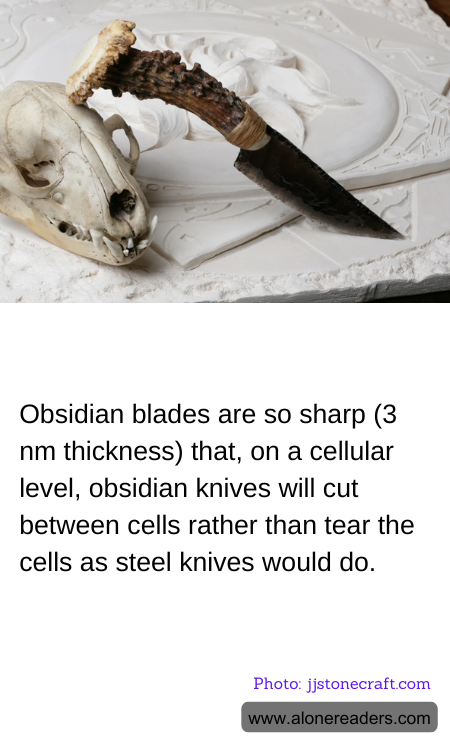
Obsidian, a naturally occurring volcanic glass, has been used by humans for thousands of years, primarily for crafting tools and weapons. Its unique properties have fascinated archaeologists and scientists alike, but one of its most remarkable features is its ability to be honed into incredibly sharp blades. Unlike conventional steel knives, which are typically used in modern kitchens and surgeries, obsidian blades can achieve an edge that is only about 3 nanometers thick. This extraordinary sharpness allows obsidian knives to cut between cells rather than tearing through them, offering a level of precision that is unmatched by most other materials.
The process of creating an obsidian blade involves carefully chipping away at the glass to produce a cutting edge that is both thin and sharp. This technique, known as knapping, has been refined over centuries, allowing skilled artisans to produce blades that are not only functional but also beautiful. The molecular structure of obsidian allows it to fracture in a way that creates a razor-sharp edge, much finer than what can be achieved with steel. This is because obsidian lacks the crystalline structure found in metals, allowing it to break along very fine lines.
The implications of such sharpness are significant, especially in fields that require extreme precision. In surgery, for instance, the use of obsidian blades can result in cleaner cuts with less tissue damage, promoting faster healing and reducing the risk of infection. This is because the blade's ability to slice between cells minimizes the trauma to surrounding tissues. While obsidian is not commonly used in modern surgical procedures due to its fragility and the difficulty in sterilizing glass, it remains a subject of interest for researchers exploring new ways to improve surgical outcomes.
Beyond its practical applications, the sharpness of obsidian blades also offers a fascinating glimpse into the ingenuity of ancient cultures. Long before the advent of metallurgy, early humans recognized the potential of this volcanic glass and developed sophisticated techniques to harness its properties. The use of obsidian tools is a testament to human innovation and adaptability, demonstrating how our ancestors were able to manipulate natural materials to meet their needs.
In conclusion, the unparalleled sharpness of obsidian blades highlights the incredible potential of natural materials when combined with human ingenuity. While modern technology has largely replaced obsidian in everyday use, its legacy endures in the fields of archaeology and experimental surgery. The ability of obsidian knives to cut between cells rather than tearing them apart is a reminder of the delicate balance between nature and technology, and the endless possibilities that arise when the two are brought together.