More About This Card
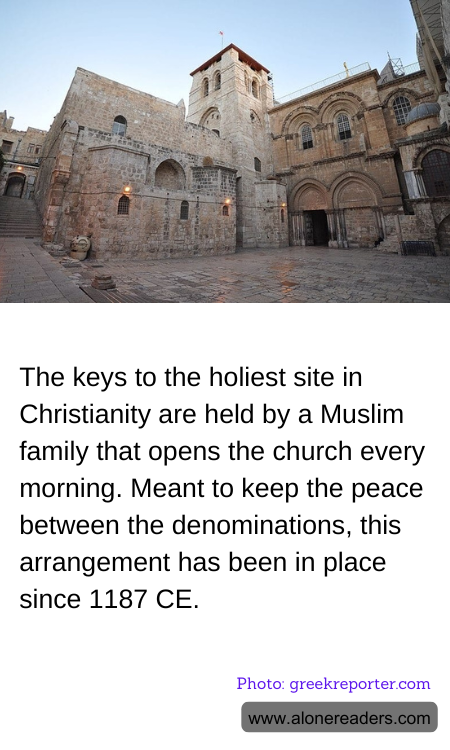
In the heart of Jerusalem's Old City, a unique tradition has persisted for over eight centuries, embodying a message of coexistence and mutual respect. The Church of the Holy Sepulchre, revered as the site of Jesus Christ's crucifixion, burial, and resurrection, is one of Christianity's most sacred places. Yet, in a remarkable testament to interfaith harmony, the keys to this holy site are entrusted to a Muslim family, the Nuseibehs, who have been the custodians since 1187 CE.
This arrangement was established by the Muslim leader Salah ad-Din, known in the West as Saladin, after he recaptured Jerusalem from the Crusaders. To maintain peace among the various Christian denominations that lay claim to the church, Saladin entrusted the keys to a neutral party. The Nuseibeh family, respected for their integrity and impartiality, were chosen for this significant role. Every morning, a member of the family opens the church, and every evening, they close it, a ritual that has continued unbroken for generations.
The Church of the Holy Sepulchre is a complex tapestry of Christian sects, including Greek Orthodox, Armenian Apostolic, Roman Catholic, Coptic Orthodox, Ethiopian Orthodox, and Syriac Orthodox. Each denomination has its own chapel and specific times for worship, often leading to disputes over space and rituals. The presence of a neutral keyholder helps to mitigate these tensions, ensuring that the church remains accessible to all.
This arrangement is not merely a practical solution but a powerful symbol of interfaith cooperation. It underscores the possibility of peaceful coexistence among different religious communities, even in a region often marked by conflict. The Nuseibeh family's role is a daily reminder that mutual respect and understanding can transcend religious and cultural divides.
The tradition of a Muslim family holding the keys to Christianity's holiest site is a story that resonates with people around the world. It highlights the importance of dialogue and collaboration in fostering peace and unity. In a world where religious and cultural differences often lead to division, the Church of the Holy Sepulchre stands as a beacon of hope, demonstrating that harmony is achievable through shared responsibility and respect.
As visitors from all corners of the globe gather at the church, they witness not only the historical and spiritual significance of the site but also the enduring legacy of a simple yet profound act of trust. The Nuseibeh family's stewardship is a testament to the enduring power of faith, not just in a religious sense, but in humanity's capacity for understanding and cooperation. This centuries-old tradition continues to inspire, offering a timeless lesson in the art of peacekeeping.