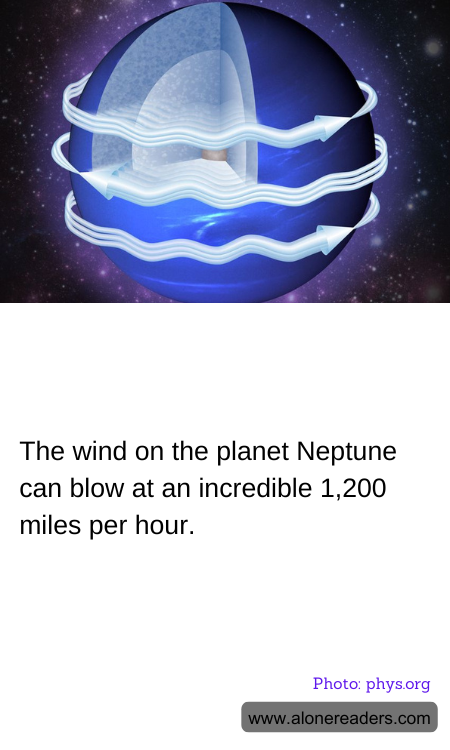
Neptune, the eighth and farthest planet from the Sun in our solar system, is a world of extremes. Known for its striking blue hue, Neptune is not only a visual marvel but also a dynamic and turbulent planet. One of the most fascinating aspects of Neptune is its incredibly powerful winds, which can reach speeds of up to 1,200 miles per hour. These winds make Neptune the windiest planet in our solar system, a fact that continues to intrigue scientists and space enthusiasts alike.
The winds on Neptune are a result of its unique atmospheric conditions. The planet's atmosphere is composed primarily of hydrogen, helium, and traces of methane, which gives it its characteristic blue color. The methane absorbs red light and reflects blue, but it is the planet's internal heat that plays a crucial role in driving its fierce winds. Unlike Earth, where the Sun is the primary source of atmospheric energy, Neptune generates more heat than it receives from the Sun. This internal heat, combined with the planet's rapid rotation, creates a dynamic environment where winds can reach supersonic speeds.
These winds are not just a scientific curiosity; they are a testament to the complex and mysterious nature of Neptune. The planet's weather patterns are dominated by massive storms and dark spots, similar to Jupiter's Great Red Spot. These storms can last for years and are driven by the high-speed winds that sweep across the planet's surface. The most famous of these storms, the Great Dark Spot, was first observed by the Voyager 2 spacecraft in 1989. Although it has since disappeared, new storms continue to form, showcasing the ever-changing nature of Neptune's atmosphere.
Understanding the winds on Neptune is not just about appreciating the planet's beauty and complexity; it also provides valuable insights into atmospheric dynamics that can be applied to other planets, including Earth. By studying Neptune, scientists can learn more about how atmospheres behave under different conditions, which can help improve weather prediction models and deepen our understanding of planetary science.
Neptune's winds are a reminder of the incredible diversity and wonder of our solar system. They challenge our understanding of what is possible and inspire us to continue exploring the cosmos. As we develop new technologies and missions to study distant planets, Neptune remains a tantalizing target, promising new discoveries and insights into the workings of our universe. Whether viewed through the lens of a telescope or the data from a spacecraft, Neptune's winds are a powerful symbol of the dynamic and ever-changing nature of the planets that share our solar system.
