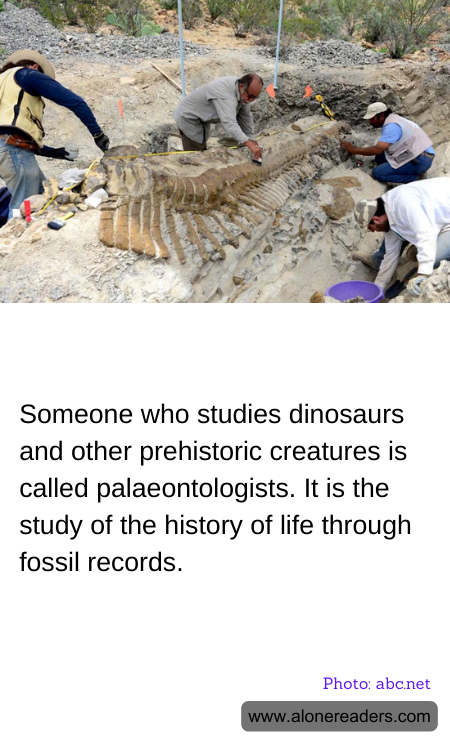
Paleontology is a fascinating field that delves into the ancient past, exploring the history of life on Earth through the study of fossils. Those who dedicate their lives to this scientific pursuit are known as paleontologists. These experts play a crucial role in uncovering the mysteries of prehistoric life, providing insights into the evolution of organisms, and helping us understand the planet's dynamic history.
Paleontologists study a wide array of fossilized remains, from the colossal bones of dinosaurs to the delicate imprints of ancient plants and microorganisms. Their work involves meticulous excavation, careful analysis, and often, a bit of detective work. By examining fossils, paleontologists can reconstruct the appearance, behavior, and environment of extinct species, offering a glimpse into a world that existed millions of years before humans walked the Earth.
The study of paleontology is not just about dinosaurs, although these giant reptiles often capture the public's imagination. It encompasses all forms of ancient life, including mammals, birds, fish, insects, and even microscopic organisms. Each fossil discovery adds a piece to the puzzle of Earth's history, helping scientists trace the lineage of species and understand the processes that have shaped life over eons.
Paleontologists use a variety of tools and techniques to conduct their research. Fieldwork is a significant component, requiring them to travel to remote locations where fossils are likely to be found. Once a fossil is unearthed, it is carefully extracted and transported to a laboratory for further study. Advanced technologies, such as CT scanning and 3D modeling, allow paleontologists to examine fossils in detail without damaging them, revealing intricate structures and providing new insights into ancient life forms.
The findings of paleontologists have profound implications beyond satisfying our curiosity about the past. They contribute to our understanding of biodiversity, extinction events, and climate change. By studying how life on Earth has responded to past environmental shifts, paleontologists can offer valuable perspectives on current ecological challenges and the potential future of our planet.
Paleontology is a dynamic and ever-evolving field, with new discoveries constantly reshaping our understanding of the past. It is a discipline that requires patience, precision, and a passion for exploration. For those who pursue it, the rewards are immense, offering the chance to uncover the secrets of ancient worlds and contribute to the broader narrative of life on Earth. Whether through the discovery of a new dinosaur species or the analysis of ancient ecosystems, paleontologists continue to illuminate the rich tapestry of our planet's history, inspiring awe and wonder in people of all ages.
