More About This Card
Crabs are fascinating creatures that inhabit our oceans, rivers, and even some land areas. One of the most intriguing aspects of their biology is their remarkable ability to regenerate lost limbs. This regenerative capability is not only a testament to the resilience of these crustaceans but also a subject of great interest to scientists and nature enthusiasts alike.
When a crab loses a leg or claw, whether due to predation, conflict, or accident, it is not a permanent loss. Instead, crabs have the extraordinary ability to regrow these limbs over time. This process, known as regeneration, is a complex biological phenomenon that allows crabs to restore their functionality and maintain their survival in the wild. The regeneration process begins almost immediately after a limb is lost. The crab's body initiates a healing process at the site of the injury, forming a protective covering over the wound. Beneath this covering, new cells begin to grow and differentiate into the various tissues needed to form a new limb.
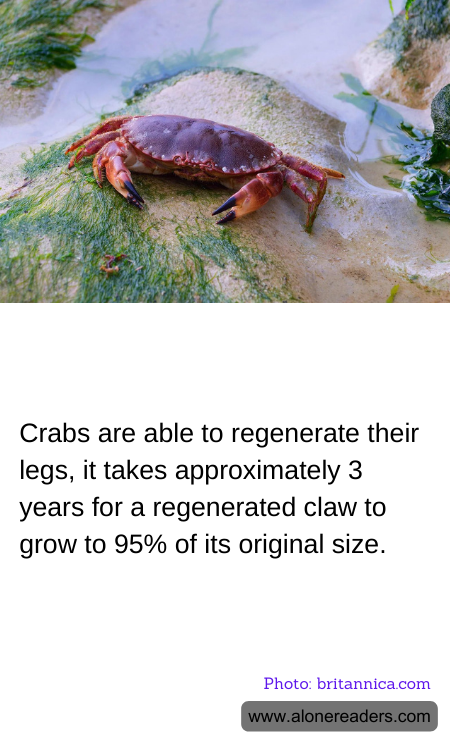
The time it takes for a crab to regenerate a limb can vary depending on several factors, including the crab's age, species, and environmental conditions. However, it generally takes about three years for a regenerated claw to grow to approximately 95% of its original size. This gradual growth ensures that the new limb is functional and capable of performing the necessary tasks for the crab's survival, such as feeding and defense.
The ability to regenerate limbs is not unique to crabs; it is a trait shared by several other species, including starfish and certain types of lizards. However, the efficiency and effectiveness with which crabs can regrow their limbs make them particularly interesting to researchers studying regenerative biology. Understanding the mechanisms behind this process could have significant implications for medical science, particularly in the field of regenerative medicine, where scientists aim to develop ways to repair or replace damaged human tissues and organs.
For the average person, the crab's ability to regenerate its limbs is a reminder of the incredible adaptability and resilience of nature. It highlights the importance of preserving marine ecosystems, where these and other remarkable creatures thrive. By protecting their habitats, we ensure that future generations can continue to marvel at the wonders of the natural world, including the crab's extraordinary ability to bounce back from adversity.
In conclusion, the crab's regenerative abilities are a testament to the wonders of evolution and the resilience of life. As we continue to explore and understand these processes, we not only gain insights into the natural world but also open up possibilities for advancements in science and medicine. Whether you are a scientist, a nature lover, or simply someone who enjoys a good seafood dish, the crab's ability to regenerate its limbs is a fascinating topic that underscores the complexity and beauty of life on Earth.