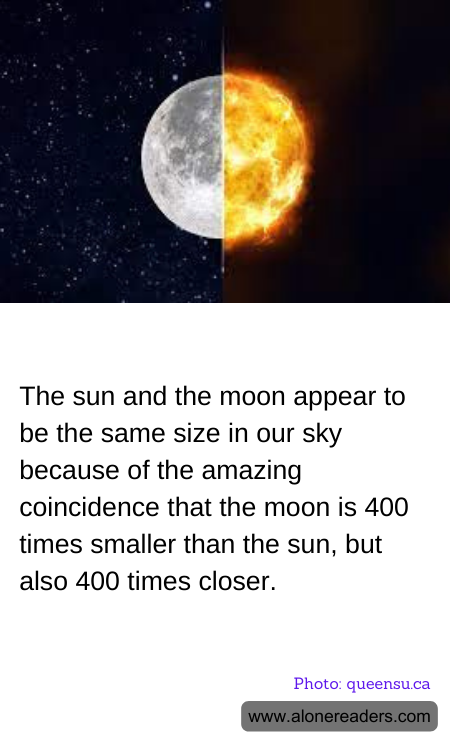
In the vast expanse of our universe, the celestial dance between the sun and the moon presents a fascinating spectacle that has captivated human imagination for millennia. One of the most intriguing aspects of this cosmic ballet is the apparent similarity in size of these two celestial bodies when viewed from Earth. This phenomenon is not just a mere coincidence but a remarkable alignment of astronomical proportions.
The sun, a massive ball of incandescent gases, is approximately 400 times larger in diameter than the moon. However, the moon is about 400 times closer to Earth than the sun. This extraordinary ratio results in both the sun and the moon appearing to be roughly the same size in our sky. This unique alignment is what allows us to witness the awe-inspiring event of a total solar eclipse, where the moon perfectly covers the sun, casting a shadow on Earth and revealing the sun's ethereal corona.
This cosmic coincidence is a reminder of the intricate and delicate balance that exists within our solar system. The sun, located about 93 million miles away, is the central powerhouse of our solar system, providing the energy necessary for life on Earth. In contrast, the moon, our closest celestial neighbor at about 238,855 miles away, influences the tides and has been a constant companion to our planet throughout its history.
The fact that the sun and the moon appear to be the same size from our vantage point on Earth has had profound cultural and scientific implications. Throughout history, civilizations have revered these celestial bodies, attributing them with divine significance. The sun has been worshipped as a symbol of life and power, while the moon has been associated with mystery and change. This apparent equality in size has also fueled myths and legends, inspiring countless stories and artistic expressions.
Scientifically, this alignment has provided astronomers with valuable opportunities to study both the sun and the moon. During a total solar eclipse, scientists can observe the sun's corona, which is usually obscured by its bright surface. This has led to significant discoveries about solar winds and the sun's magnetic field. Similarly, the study of the moon has offered insights into the history of our solar system and the processes that shaped our planet.
In conclusion, the apparent similarity in size of the sun and the moon is a testament to the wonders of our universe. It serves as a reminder of the intricate relationships that govern celestial mechanics and the beauty that arises from such cosmic coincidences. As we gaze up at the sky, whether during a solar eclipse or on a clear night, we are reminded of our place in the universe and the extraordinary nature of the world we inhabit.
