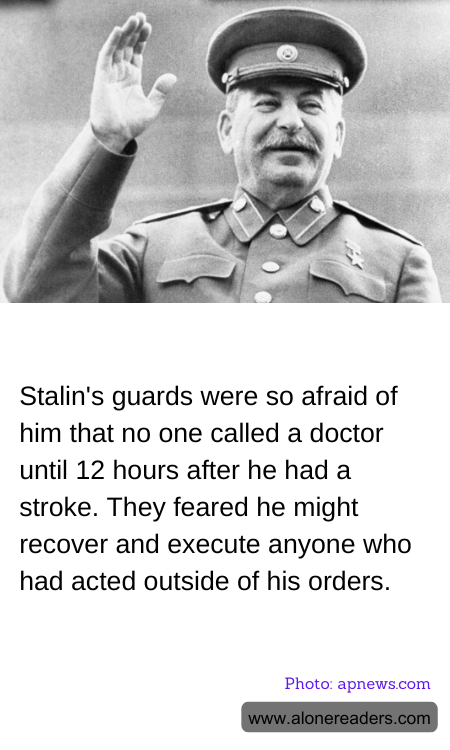
In the annals of history, few leaders have inspired as much fear and reverence as Joseph Stalin, the Soviet Union's formidable ruler from the mid-1920s until his death in 1953. Known for his iron-fisted rule and the purges that claimed the lives of millions, Stalin's reign was characterized by an atmosphere of pervasive fear and paranoia. This climate of terror extended even to those closest to him, including his personal guards and aides, who were so petrified of his wrath that they hesitated to act even in the face of a medical emergency.
On March 1, 1953, Joseph Stalin suffered a severe stroke at his dacha in Kuntsevo, near Moscow. The stroke left him incapacitated, but it was not until approximately 12 hours later that any medical assistance was summoned. The delay was not due to a lack of awareness or resources but rather a profound fear of the consequences of acting without explicit orders from Stalin himself. His guards and aides were acutely aware of the dictator's unpredictable nature and his history of executing those he perceived as disloyal or insubordinate. The fear that Stalin might recover and punish those who had intervened without his directive was paralyzing.
This incident underscores the extent to which Stalin's reign was marked by a culture of fear. His subordinates were conditioned to adhere strictly to his commands, knowing that any deviation could result in severe punishment or death. This environment of terror was not limited to his inner circle but permeated the entire Soviet apparatus, where suspicion and denunciation were rampant. The guards' hesitation to call for medical help reflects the broader climate of distrust and fear that Stalin cultivated throughout his rule.
Stalin's death on March 5, 1953, marked the end of an era defined by oppression and brutality. In the years following his demise, the Soviet Union underwent a period of de-Stalinization, as leaders sought to dismantle the cult of personality that had surrounded him and to address the injustices of his regime. However, the legacy of fear he left behind continued to influence Soviet society for decades.
The reluctance of Stalin's guards to act in his moment of need serves as a poignant reminder of the corrosive power of fear in authoritarian regimes. It illustrates how a leader's unchecked authority can create an environment where even the most basic human instincts, such as providing aid to someone in distress, are suppressed by the fear of retribution. This historical episode is a testament to the importance of fostering a culture of openness and trust, where individuals are empowered to act in the best interests of others without fear of reprisal.
