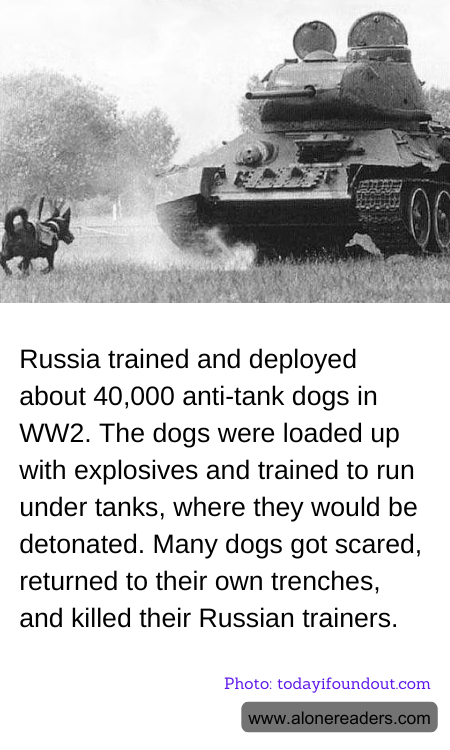
More About This Card
During World War II, the Soviet Union faced the formidable challenge of countering the heavily armored tanks of the German Wehrmacht. In a bid to turn the tide of battle, the Soviet military devised an unconventional and controversial strategy: the deployment of anti-tank dogs. This initiative involved training approximately 40,000 dogs to carry explosives and run under enemy tanks, where the explosives would detonate, ideally disabling the armored vehicles.
The concept of using dogs in warfare was not entirely new, but the scale and method employed by the Soviets were unprecedented. The dogs, primarily Alsatians and other large breeds, were trained to associate the underside of tanks with food. Trainers would starve the dogs and then place food under stationary tanks, conditioning the animals to seek out the tanks in search of sustenance. Once the dogs were trained, they were fitted with explosive packs equipped with a lever that would trigger detonation upon contact with the tank's hull.
Despite the ingenuity behind the plan, the execution was fraught with challenges. The battlefield was a chaotic and terrifying environment, and many dogs, understandably frightened by the noise and confusion, would run back to their handlers instead of towards the enemy tanks. Tragically, this often resulted in the explosives detonating within the Soviet trenches, causing unintended casualties among the trainers and soldiers.
The use of anti-tank dogs was met with mixed results. While there were instances where the dogs successfully disabled enemy tanks, the overall effectiveness of the program was limited. The German forces quickly adapted by shooting the dogs on sight or employing strategies to scare them away. Moreover, the ethical implications of using animals in such a manner sparked controversy and criticism, both during and after the war.
In retrospect, the anti-tank dog program serves as a poignant reminder of the desperation and innovation that can arise in times of war. It highlights the lengths to which nations will go to gain an advantage, as well as the moral dilemmas that accompany such decisions. While the program was ultimately discontinued, it remains a fascinating and somber chapter in the history of military tactics, illustrating the complex interplay between human ingenuity and the ethical treatment of animals.