More About This Card
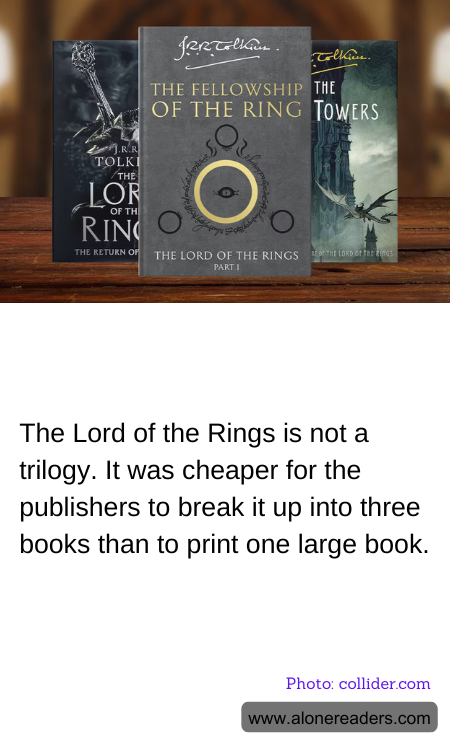
J.R.R. Tolkien's epic fantasy, "The Lord of the Rings," is often referred to as a trilogy, but this is a common misconception. In reality, Tolkien intended for his masterpiece to be a single, cohesive novel. The decision to divide it into three separate volumes was primarily a practical one, driven by the economic and logistical constraints of the time.
When Tolkien completed "The Lord of the Rings" in 1949, it was a massive manuscript, sprawling over a thousand pages. Publishing such a voluminous work as a single book posed significant challenges. Post-war Britain was still grappling with paper shortages, and the cost of printing a book of that size was prohibitively high. Publishers were understandably wary of the financial risk involved in producing and distributing such a large tome.
To mitigate these concerns, Tolkien's publisher, Allen & Unwin, proposed splitting the novel into three parts. This approach not only made the production process more feasible but also reduced the financial risk by allowing the publisher to gauge the market's response to the first volume before committing to the subsequent ones. Thus, "The Fellowship of the Ring," "The Two Towers," and "The Return of the King" were born, each released between 1954 and 1955.
While this division was practical from a publishing standpoint, it inadvertently shaped the way readers and the broader culture perceived the work. The three-volume format lent itself to the notion of a trilogy, a term that has persisted despite Tolkien's original vision. In his correspondence, Tolkien expressed some dissatisfaction with the division, noting that the story was conceived as a single, continuous narrative. He even went so far as to suggest alternative titles for the volumes, emphasizing their interconnectedness.
Despite the initial compromise, the decision to publish "The Lord of the Rings" in three parts did not detract from its impact. The books quickly gained a devoted following, and their influence on the fantasy genre is immeasurable. The story's depth, complexity, and richly imagined world have captivated generations of readers, transcending the format in which it was presented.
In the years since its publication, "The Lord of the Rings" has been reissued in various formats, including single-volume editions that align more closely with Tolkien's original intent. These editions serve as a reminder of the story's unity and the author's vision for his magnum opus. While the trilogy label persists in popular culture, understanding the historical context of its publication offers a deeper appreciation for Tolkien's work and the practical considerations that shaped its initial presentation to the world.