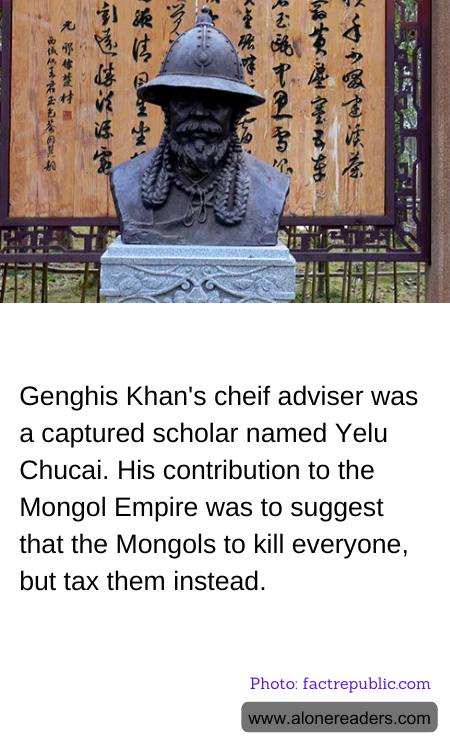
More About This Card
In the annals of history, Genghis Khan is often remembered as a fierce conqueror whose military campaigns reshaped the world. However, behind the scenes of his vast empire was a man whose wisdom and foresight helped shape the Mongol Empire's administrative policies. This man was Yelu Chucai, a captured scholar who became one of Genghis Khan's most trusted advisers. His contributions were pivotal in transforming the Mongol approach from sheer conquest to a more sustainable governance model.
Yelu Chucai was a Khitan statesman and scholar who initially served the Jin dynasty before being captured by the Mongols. Recognizing his intellect and potential, Genghis Khan appointed him as an adviser. Yelu Chucai's most significant contribution to the Mongol Empire was his suggestion to shift from a policy of mass extermination to one of taxation. At a time when the Mongols were known for their ruthless military tactics, Yelu Chucai proposed a more pragmatic approach that would ensure the long-term prosperity of the empire.
The Mongols, under Genghis Khan, had a reputation for decimating entire populations in their quest for expansion. This strategy, while effective in instilling fear and securing quick victories, was not sustainable in the long run. Yelu Chucai understood that the true wealth of an empire lay not in the destruction of its people but in their productivity. By advocating for taxation instead of annihilation, he introduced a system that allowed the Mongols to benefit economically from the regions they conquered.
Yelu Chucai's proposal was revolutionary for its time. It not only preserved countless lives but also laid the foundation for a more structured and efficient administration within the Mongol Empire. By implementing a taxation system, the Mongols could generate revenue to support their military campaigns and infrastructure projects, thus ensuring the empire's stability and growth. This shift in policy also facilitated cultural exchanges and trade, enriching the Mongol Empire and its subjects.
The legacy of Yelu Chucai's advice is evident in the Mongol Empire's transformation from a nomadic warrior society to a formidable and organized state. His foresight in advocating for taxation over destruction demonstrated a deep understanding of governance and economics. It also highlighted the importance of integrating diverse perspectives and expertise into the decision-making processes of a vast empire.
In conclusion, Yelu Chucai's role as Genghis Khan's chief adviser was instrumental in shaping the Mongol Empire's administrative policies. His suggestion to tax rather than kill not only preserved lives but also ensured the empire's prosperity and longevity. This pragmatic approach to governance remains a testament to the power of wisdom and foresight in the annals of history.