More About This Card
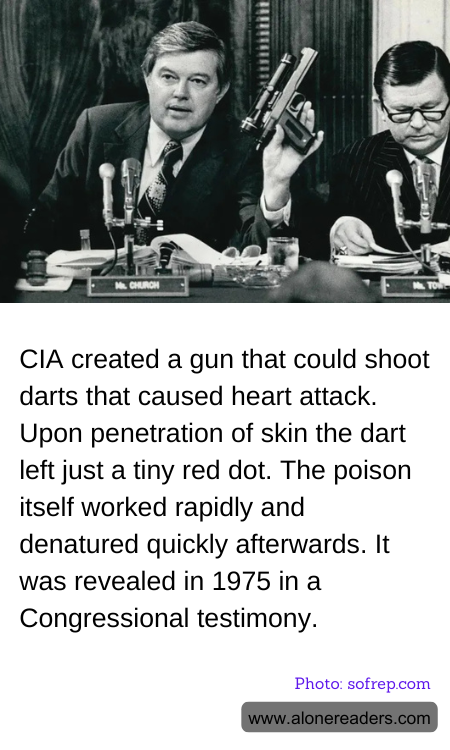
In the annals of espionage history, few revelations have been as startling as the disclosure of a clandestine weapon developed by the Central Intelligence Agency (CIA) during the Cold War era. In 1975, during a Congressional testimony, it was revealed that the CIA had engineered a gun capable of firing darts that could induce a heart attack in its target. This weapon, shrouded in secrecy, was designed to leave minimal evidence of its use, making it a tool of choice for covert operations.
The gun, which resembled a conventional firearm, was engineered to shoot small darts that were nearly undetectable upon impact. These darts, upon penetrating the skin, left only a tiny red dot, a mark so inconspicuous that it could easily be overlooked during a routine examination. The true genius—and danger—of this weapon lay in the poison that coated the dart. This toxin was formulated to act rapidly, inducing a heart attack in the victim, and then denature quickly, leaving no trace of its presence in the body. This made it nearly impossible for forensic experts to determine the cause of death as anything other than natural.
The revelation of this weapon during the Congressional hearings of 1975 sent shockwaves through the public and political spheres. It raised profound ethical questions about the extent of covert operations and the lengths to which intelligence agencies might go to achieve their objectives. The hearings, part of a broader investigation into the activities of the CIA, were instrumental in bringing to light various controversial practices and led to increased oversight and regulation of intelligence activities.
The existence of such a weapon underscores the lengths to which intelligence agencies have historically gone to maintain a strategic advantage. During the Cold War, a period marked by intense rivalry and suspicion between the United States and the Soviet Union, the development of such tools was often justified as necessary for national security. However, the moral implications of using a weapon that could kill without leaving a trace were, and remain, deeply troubling.
In the years since the 1975 testimony, the CIA and other intelligence agencies have faced increased scrutiny and calls for transparency. While the Cold War has ended, the legacy of such weapons continues to provoke debate about the ethical boundaries of espionage and the responsibilities of intelligence agencies in a democratic society.
This revelation serves as a reminder of the shadowy world of espionage, where the lines between right and wrong are often blurred. It highlights the need for ongoing vigilance and accountability to ensure that the pursuit of security does not come at the cost of ethical integrity. As technology continues to advance, the lessons from the past remain relevant, urging caution and reflection in the development and deployment of new tools of intelligence.