More About This Card
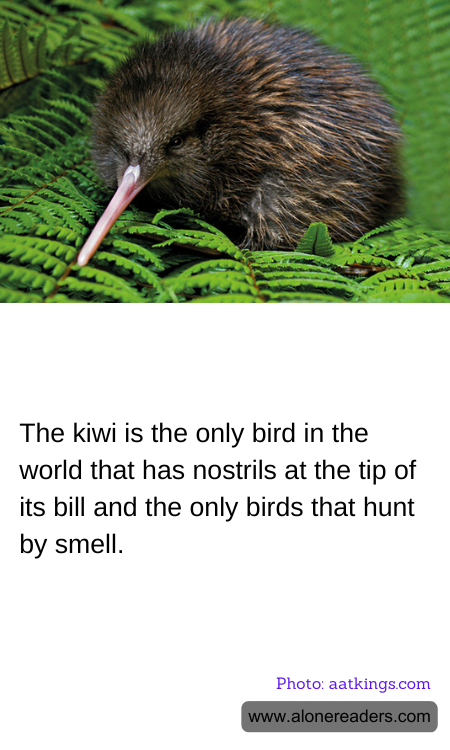
In the lush, verdant landscapes of New Zealand, a unique bird quietly forages through the underbrush, its peculiar features setting it apart from all other avian species. The kiwi, a flightless bird endemic to this island nation, is not only an emblem of New Zealand's natural heritage but also a fascinating subject of study due to its extraordinary adaptations. Among its most remarkable features is the placement of its nostrils at the tip of its bill, a trait that distinguishes it from every other bird in the world.
Unlike most birds, which have nostrils located at the base of their beaks, the kiwi's nostrils are positioned at the very tip. This adaptation is not merely a quirky anatomical feature; it serves a critical function in the kiwi's survival. The kiwi is primarily nocturnal and relies heavily on its sense of smell to locate food. Its diet consists mainly of insects, worms, and other small invertebrates hidden beneath the forest floor. By having nostrils at the tip of its bill, the kiwi can probe the ground and detect the scent of its prey with remarkable precision.
This olfactory prowess makes the kiwi one of the few birds in the world that hunts by smell. While many birds rely on sight and sound to find food, the kiwi's sense of smell is its primary tool for foraging. This adaptation is particularly advantageous in the dense, dark environments where kiwis thrive. As the bird snuffles through the leaf litter, its sensitive nostrils pick up the faintest scents, guiding it to a hidden meal. This unique hunting method underscores the kiwi's evolutionary journey, shaped by the isolated and predator-free environment of New Zealand.
The kiwi's reliance on smell is complemented by other adaptations that suit its nocturnal lifestyle. Its eyes, though small, are well-suited to low-light conditions, and its plumage, resembling coarse hair, provides excellent camouflage among the forest floor's debris. These features, combined with its keen sense of smell, make the kiwi a master of its domain, despite its inability to fly.
However, the kiwi's specialized adaptations also highlight its vulnerability. As human activity encroaches on its habitat and introduces new predators, the kiwi faces significant challenges. Conservation efforts are crucial to ensure the survival of this extraordinary bird, whose unique characteristics offer invaluable insights into the diversity of life on Earth.
In celebrating the kiwi, we are reminded of the intricate tapestry of evolution and the myriad ways in which life adapts to its surroundings. The kiwi's story is one of resilience and adaptation, a testament to the wonders of the natural world and the importance of preserving it for future generations. As we learn more about this remarkable bird, we gain a deeper appreciation for the delicate balance of ecosystems and the unique creatures that inhabit them.