More About This Card
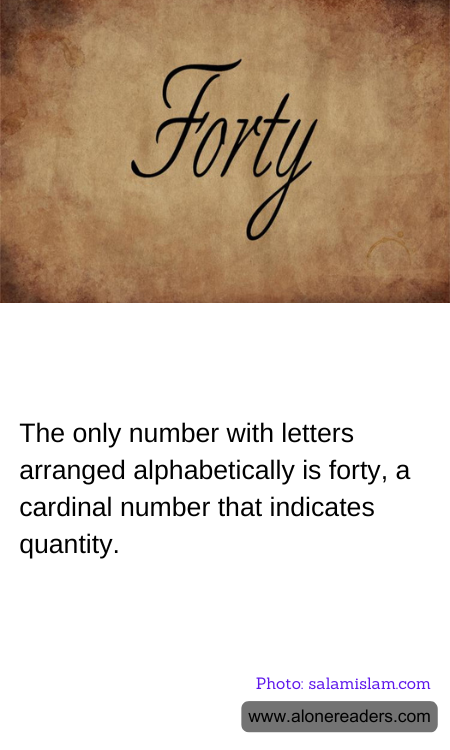
In the vast world of numbers, where digits and figures reign supreme, there exists a unique and intriguing fact that often goes unnoticed. Among all the cardinal numbers, which are used to indicate quantity, there is only one whose letters are arranged in alphabetical order: forty. This seemingly trivial detail is a delightful quirk of the English language that captures the imagination and invites curiosity.
The number forty, representing the quantity of four tens, holds a special place not just in mathematics but also in linguistics. When spelled out, the letters F, O, R, T, and Y follow the sequence of the English alphabet, a characteristic not shared by any other cardinal number. This peculiarity makes forty a linguistic anomaly, a rare gem in the numerical lexicon that stands out for its orderly arrangement.
The uniqueness of forty extends beyond its alphabetical alignment. It is a number that frequently appears in various cultural, historical, and scientific contexts. In the Bible, the number forty is often associated with periods of trial, testing, and transformation, such as the forty days and nights of rain during the Great Flood or the forty years the Israelites spent wandering in the desert. In the realm of science, forty is the atomic number of zirconium, a metal known for its resistance to corrosion and high melting point.
Moreover, forty is a milestone in human life, often marking significant transitions. Turning forty is traditionally seen as entering middle age, a time for reflection and reassessment. It is a period when many people evaluate their achievements and set new goals for the future. This number, therefore, carries a weight of significance that transcends its numerical value, symbolizing growth, maturity, and the passage of time.
The alphabetical arrangement of forty is a reminder of the hidden patterns and connections that exist in language and numbers. It encourages us to look beyond the surface and appreciate the intricacies of the world around us. This simple yet fascinating fact can serve as a conversation starter, a fun trivia question, or a gentle nudge to explore the wonders of language and mathematics further.
In conclusion, the number forty stands out not only for its mathematical properties but also for its unique alphabetical order. It is a testament to the beauty and complexity of language, offering a glimpse into the delightful quirks that make English such a rich and engaging medium of communication. Whether you are a linguist, a mathematician, or simply someone with a love for trivia, the story of forty is a charming reminder of the unexpected surprises that numbers can hold.