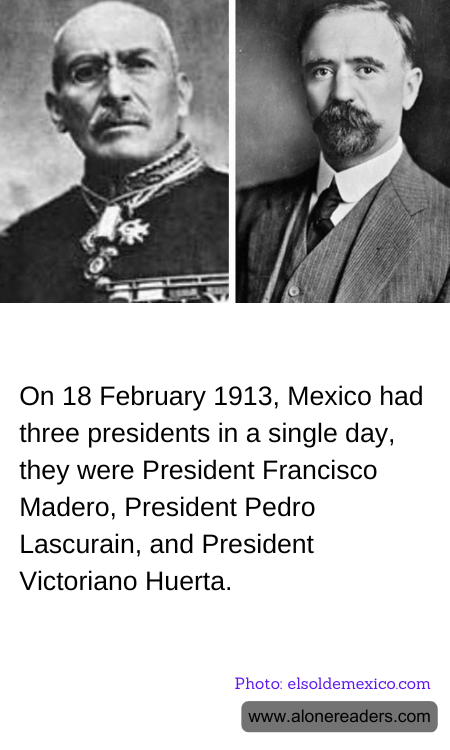
On February 18, 1913, Mexico experienced an extraordinary political upheaval that saw the country governed by three different presidents in a single day. This remarkable event unfolded during a period of intense political instability and revolution, marking a pivotal moment in Mexican history.
The day began with Francisco Madero as the sitting president. Madero had risen to power in 1911, following the overthrow of the long-standing dictator Porfirio Díaz. His presidency, however, was fraught with challenges. Madero's efforts to implement democratic reforms and address social inequalities were met with resistance from various factions, including disgruntled military leaders and political opponents. The tension reached a boiling point in February 1913, during what is known as the Ten Tragic Days (La Decena Trágica), a period of violent conflict in Mexico City.
Amidst the chaos, a coup was orchestrated by General Victoriano Huerta, who had been a trusted military leader under Madero. On February 18, Madero was forced to resign under duress, and Pedro Lascuráin, the foreign minister, was appointed as interim president. Lascuráin's presidency was incredibly brief, lasting less than an hour. His primary role was to legitimize the transition of power to Huerta by appointing him as the new president. This maneuver was part of a prearranged plan to ensure that Huerta's ascension to power appeared constitutional, albeit under dubious circumstances.
Victoriano Huerta's assumption of the presidency marked the third leadership change of the day. Huerta's regime was characterized by authoritarian rule and was widely condemned both domestically and internationally. His government faced immediate opposition from revolutionary forces, including those led by Emiliano Zapata and Pancho Villa, who were determined to restore democratic governance and address the grievances of the Mexican people.
The events of February 18, 1913, underscored the deep divisions and volatility within Mexico during this era. The rapid succession of presidents highlighted the fragility of the political landscape and the extent to which power struggles could disrupt the nation's governance. Huerta's presidency, which lasted until 1914, was marked by continued conflict and ultimately led to his downfall, paving the way for further revolutionary changes in Mexico.
This extraordinary day in Mexican history serves as a reminder of the complexities and challenges faced by nations in times of political transition. It also illustrates the lengths to which individuals and factions will go to seize and maintain power, often at the expense of democratic principles and stability. The legacy of February 18, 1913, continues to resonate in Mexico's historical narrative, symbolizing a critical juncture in the country's ongoing quest for democracy and social justice.
